“`html
US Tech Regulation in 2024: A Wild West of Data Privacy Laws

Picture this: a massive family squabble over the future of the internet. On one side, you have individual states, each creating their own digital rules. On the other, Big Tech and the federal government are pushing for a single, unified approach. This is the heart of the debate on US tech regulation in 2024, a showdown that will define data privacy trends for years to come. The outcome will impact everything from your personal data to whether you’re approved for a loan by an AI. So, get ready, because this legal battle is just heating up.

The States Go Rogue (and We Kinda Love It)
For years, Congress has been slow to pass comprehensive tech laws. Frustrated by the lack of federal action, states have taken matters into their own hands. The most notable example is California, which introduced the California Consumer Privacy Act (CCPA), giving residents the right to know what data companies have on them and to request its deletion.
Following California’s lead, other states like Virginia, Colorado, and Utah have passed their own data privacy laws, creating a “legislative Lollapalooza” of regulations. This isn’t just about privacy; states are also tackling:
- Artificial Intelligence (AI): Colorado is working to prevent biased AI from denying people insurance.
- Content Moderation: Texas and Florida have passed laws directing social media platforms on content moderation, which are currently being challenged in court.
- Antitrust: State attorneys general are teaming up to sue tech giants for anti-competitive practices.
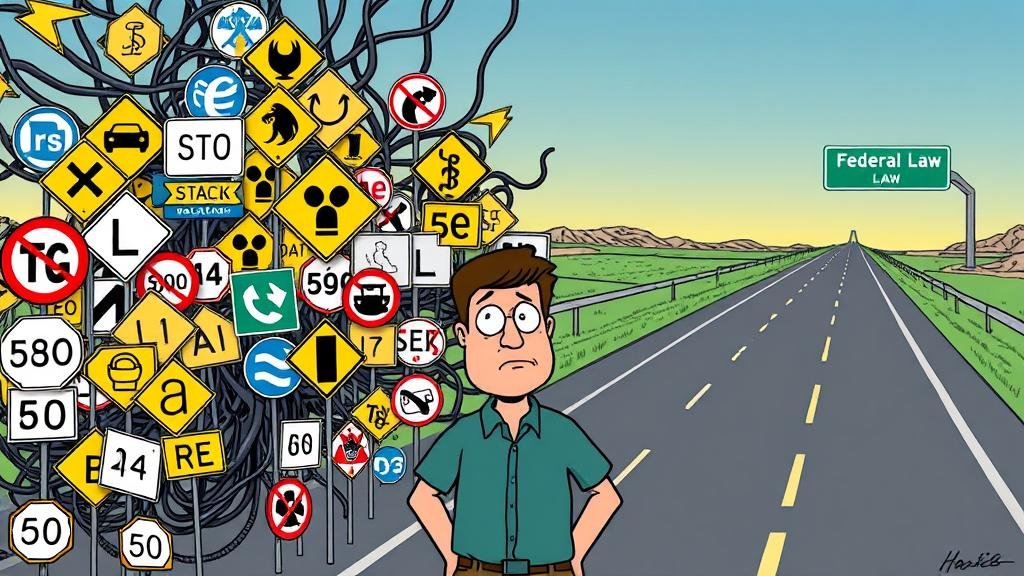
This has created what the tech industry calls a “patchwork problem,” and they are not happy about it.
Big Tech’s Plea: “Just Give Us One Rule!”
Imagine trying to follow 50 different sets of traffic laws. That’s the challenge tech companies face today. They argue that navigating this complex web of state regulations is costly and stifles innovation. Their solution? A single federal data privacy law to create a unified standard across the country.
The U.S. Chamber of Commerce supports this view, pointing out that a 50-state legal maze creates immense costs, especially for smaller businesses without large legal teams. They argue that a predictable market would foster competition and unlock a:
“$600 Billion AI Abundance Dividend.”
In short, they want simplicity: one rulebook for the entire nation.
The Resistance: “Don’t Tread on Our Digital Rights!”
Consumer advocates and state officials, however, are wary of a single federal law. They see states as “laboratories of democracy,” able to respond more quickly to the needs of their citizens than a gridlocked Congress. Their biggest fear is that a weak federal law, influenced by tech lobbyists, would become a low “ceiling” for data privacy, wiping out stronger state-level protections like the CCPA. This could result in a net loss of consumer rights.
So, What’s on the Line for You?
This debate will determine:
- Your Data Privacy: Will you have the right to delete your data everywhere, or will this be a privilege reserved for residents of certain states?
- Algorithmic Fairness: Will there be rules to prevent biased AI, or will we have to trust that algorithms are fair when we apply for a mortgage?
- Online Safety: Who will be responsible for creating rules to protect children and combat misinformation?

A Compromise? The Fabled “Federal Floor”
There is a potential middle ground: cooperative federalism. In this model, Congress would set a baseline of data privacy protections for all Americans—a “floor.” States would then be free to build upon this floor with stronger regulations. This approach would provide a basic set of digital rights for everyone while still allowing states to innovate. Consumer groups are on board, but the tech industry is less enthusiastic as it doesn’t solve their “patchwork problem.”
The Road Ahead: A Viewer’s Guide
The future of US tech regulation is being written now. As this political drama unfolds, keep an eye on:
- New Federal Bills: Look for the word “preemption.” Is the proposed law a “floor” or a “ceiling”? The difference is critical.
- Lobbying Dollars: Follow the money to see who is trying to influence the outcome.
- The State Attorneys General: This bipartisan group of legal watchdogs will be a powerful voice in the debate.
The rules governing our digital lives are too important to be decided in secret. Whether we end up with one rulebook or fifty, the game is changing.
And yes, this will be on the test.
“`