Ensemble Learning in Finance: How AI Teamwork Creates Smarter, Fairer Financial Services
Remember that one high school study group where one person brought the snacks, another made a playlist, and a third just highlighted the entire textbook in six different colors? Yeah, I was the third guy. By combining our… ahem… talents, we somehow scraped through that final exam better than any of us would have alone.
Well, it turns out the super-brains in AI in finance had the same idea. It’s called ensemble learning, and it’s the tech equivalent of making a bunch of robots form a study group to ace a test. And here at Creditnewsinsider, we’re obsessed with the cutting-edge stuff that secretly runs the world of finance. Ensemble learning is one of those VIPs, a core machine learning technique working behind the curtain on everything from your credit score to fraud detection in finance.
So, grab a seat. Class is in session. Don’t worry, it’s the fun kind.
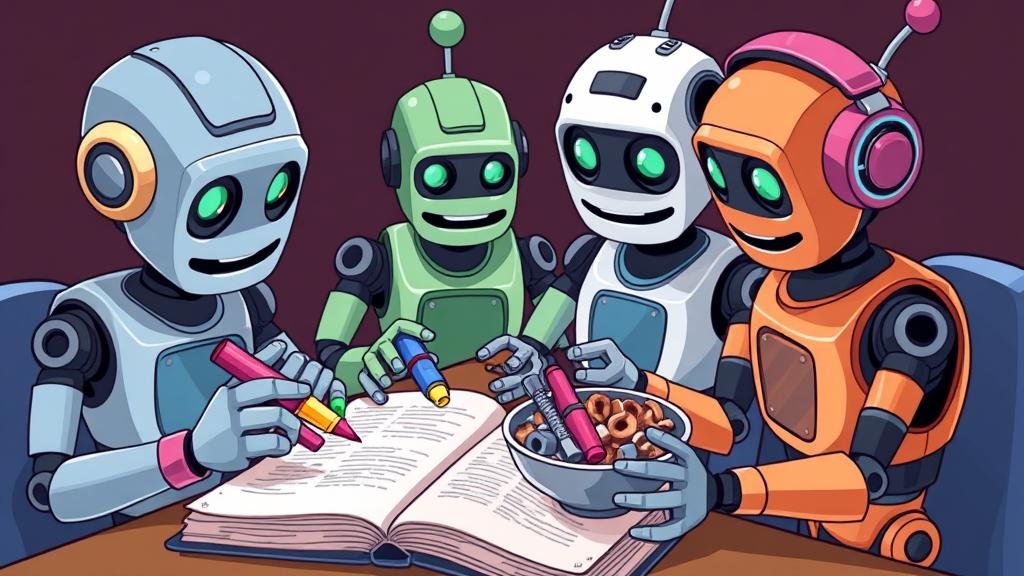
So, What’s the Big Deal with This AI ‘Study Group’?
In the simplest terms, ensemble learning is the art of telling one “genius” AI model, “You’re great, but you’re not that great,” and then hiring a whole team of models to do the job instead.
Instead of hoping a single, all-knowing algorithm gets it right, data scientists train an entire squad. Each model gets a vote on the final answer, and the majority wins. It’s the “wisdom of the crowd” in digital form. You feel me? It’s like asking one friend for restaurant advice versus polling your entire group chat. The group chat usually wins (and starts a fight about pineapple on pizza, but I digress).
As the fine folks at GeeksforGeeks put it, “Ensemble learning is a machine learning technique that involves combining multiple individual models to create a more powerful and accurate model.” They just say it with fewer dad jokes.
For this AI study party to really pop, you need two things:
- A Wonky, Diverse Team: You can’t have a study group where everyone is an expert in 18th-century poetry and clueless about math. You need variety! In AI, this means the models (our “students”) have to be different—maybe they use different algorithms or were trained on different parts of the data.
- A Smart Way to Tally the Votes: You need a boss to combine all their opinions. Sometimes it’s a simple “majority rules” vote. Other times, it’s a more complex system where the “mathlete” model gets a bigger say on number problems.
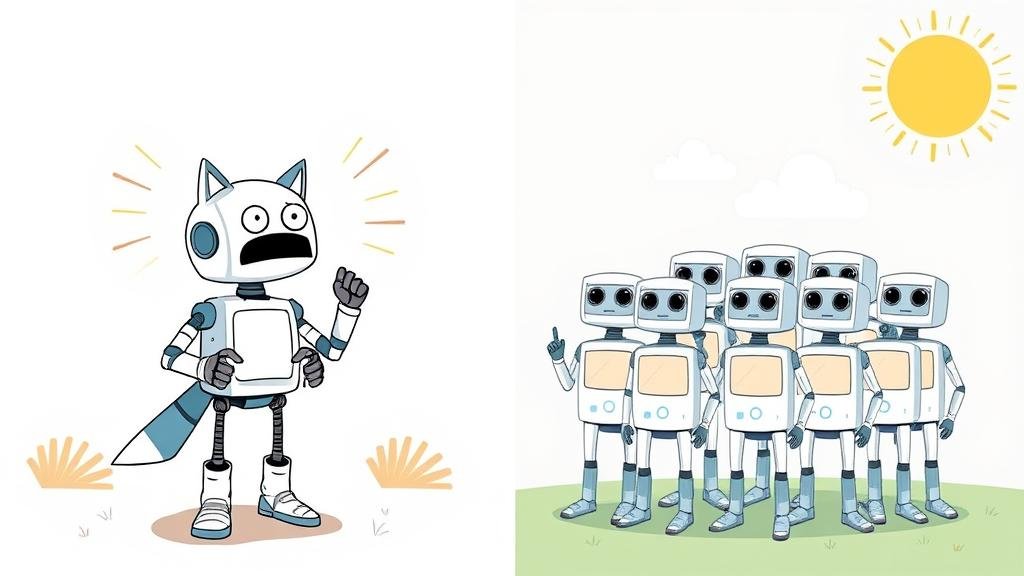
Why a Robot Study Group Is Better Than a Lone Wolf
Let’s be real, putting all your faith in one model is risky. It’s like betting your entire vacation fund on a single, questionably-trained squirrel predicting the weather. An ensemble, on the other hand, is a game-changer for financial services.
Sky-High Accuracy
This is the main event. By pooling the “knowledge” of several models, the final prediction is way more accurate. If one model zigs when it should have zagged, the others are there to outvote it and keep things on track. As the wizards at Lyzr.ai said, “One model is good, but multiple models are better!” It’s a safety net for your data.
More Robust Than Your Dad’s Old Nokia
Ensemble models are the ultimate defense against overfitting. Overfitting is what happens when an AI model “memorizes” the practice test instead of actually learning the subject. It’ll ace the test it’s seen before but completely bomb the real exam if the questions are even slightly different. We all knew that kid.
Our study group analogy is perfect here. The group that discusses concepts will do better on the final than the one kid who just memorized flashcards. An ensemble acts like that collaborative discussion, helping the AI handle brand-new, real-world data without having a digital meltdown.
It’s Just… Fairer
Every AI model has its own little quirks and biases. It’s like my uncle who thinks every problem can be solved with duct tape. By bringing together models with different biases, they tend to cancel each other out. In something as serious as credit scoring models, one model might be a little too tough on freelancers, while another might be too lenient on someone else. Combine them? Cue dramatic pause. You get a much more balanced and fair assessment.
The Three Types of AI Study Sessions
Data scientists have a few clever tricks for making their AI models “study” together. Here are the big three, explained with our trusty (and slightly tortured) analogy.
1. Bagging (The Potluck Method)
The Analogy: Picture this. Every student in the study group gets a slightly different, photocopied chapter of the textbook (some pages are missing, some are smudged). They all go off into a corner to study their unique version. Then, they come together for the final exam and vote on each answer. Simple, effective, and beautifully chaotic.
How it Works: In bagging, you train a bunch of models at the same time, but each one only gets to see a random piece of the data. Since each model has a slightly different worldview, their combined vote is much stronger. The most famous example is the Random Forest—it’s basically the most popular kid in the bagging club.
2. Boosting (The High-Stress Cram Session)
The Analogy: This is the sequential, caffeine-fueled panic study. The group takes a practice quiz. The teacher circles all the wrong answers in bright red ink. For the next round, the group only studies the topics they botched. They repeat this brutal cycle of shame and improvement until they’re experts on their weakest subjects.
How it Works: Boosting trains models one after another. The first model makes its predictions. The algorithm then gives the next model a mission: “Go fix the mistakes the last guy made!” Each new model “boosts” the team by focusing specifically on the errors of its predecessor. It’s tough love, but it works.
3. Stacking (The ‘Avengers, Assemble!’ Method)
The Analogy: This one’s fancy. Your study group has an “expert” for each subject: a math genius, a history buff, and a science whiz. They all do their work separately. Then, you bring in a “team captain” who isn’t an expert in anything but is brilliant at knowing who to trust for which question. The captain looks at all the experts’ answers and makes the final, authoritative call.
How it Works: In stacking, you train a few totally different types of models. Then you feed all their predictions to a final “meta-model.” This meta-model’s only job is to learn how to best combine the predictions from the all-star team below it. It’s the manager who knows how to get the most out of their players.

But How Does This Affect My Wallet?
“Cool story, blog writer,” you might be thinking, “but why should I care?” Ah, because this tech is already all up in your financial business, forming the backbone of modern financial planning and services. Here at Creditnewsinsider, this is the stuff we live for:
- Smarter Credit Scores: Lenders use ensembles to build more accurate credit scoring models. By combining different algorithmic perspectives, they can make better decisions, which means fairer approvals and rates for everyone.
- Fraud-Busting Ninjas: That “Was this you?” text you got at 2 AM after an online shopping spree for 50 rubber chickens? You can thank an ensemble model. A single rule might miss a clever scam, but a team of models, excels at fraud detection in finance, all looking for different weird patterns, is like a high-tech security detail for your account.
- Wall Street’s Crystal Ball (Sort Of): Investment firms use ensembles for stock market prediction. By combining dozens of different signals, including sentiment analysis from news and social media (a key part of NLP in finance), they can spot opportunities with a much higher chance of success.
Final Exam: The Future is a Team Sport
Turns out, the most powerful lesson from high school wasn’t the Pythagorean theorem. It was that collaboration gets you further than going it alone. In the world of machine learning in finance, a diverse team of AI models can solve problems that a single genius model can’t even touch.
As AI gets woven deeper into our lives—especially in high-stakes fields like finance—this team-up approach isn’t just a clever trick; it’s how we build smarter, safer systems for everyone.
So next time you hear about some AI breakthrough, just picture a bunch of little robots quizzing each other in a library. Because the best solutions come from the wisdom of many.
And yes, this *will* be on the test. Just kidding. Or am I?