China’s High-Stakes Gamble for Chip Independence Amidst the US-China Tech War
Why China is Aiming for Chip Independence
At its heart, China’s ambition for semiconductor self-sufficiency is a modern tale of sovereignty. Think of it as a national desire to control one’s own destiny, much like wanting to move out of your parents’ house to set your own rules. For Beijing, this means breaking free from its reliance on foreign technology, a vulnerability that has become a major geopolitical pressure point.
The nation’s leaders saw their dependence on tech from the U.S., Taiwan, and South Korea as a strategic weakness. This fear became a reality when US sanctions crippled tech giants like Huawei, effectively disrupting China’s economic ambitions. The message was clear: relying on another country’s hardware means they can always pull the plug, putting your future at risk.
This realization has fueled the “Made in China 2025” initiative, a state-funded push to develop a domestic semiconductor industry. The goal extends beyond simple self-sufficiency; China aims to design the next generation of processors that will power artificial intelligence, quantum computing, and future technological innovations. This ambition sets them on a direct collision course with the current leaders in the chip war.

Beijing’s Multi-Billion Dollar Gamble
How does a nation solve a dependency issue of this magnitude? For Beijing, the answer is a massive financial investment, pouring hundreds of billions of dollars into its domestic chip industry. This funding is directed toward three primary objectives:
- Building Fabrication Plants: China is aggressively constructing semiconductor fabrication plants (fabs), with companies like SMIC receiving substantial state support.
- Nurturing “Little Giants”: The government is fostering a new generation of startups specializing in various aspects of the chip-making process, creating a comprehensive domestic ecosystem.
- Recruiting Top Talent: Beijing is actively recruiting top engineers from around the world with highly attractive salaries and research grants, building a team of experts to drive their mission forward.
This isn’t just industrial policy; it’s a national mission. For China, failure in this endeavor is not just a setback—it’s an existential threat to its long-term strategic goals.

The Global Regulatory Clampdown
The international community, led by the United States, has not stood by idly. Washington has implemented a series of export controls to slow China’s progress, framing it as a matter of national security. The concern is that a technologically dominant China could shift the global balance of power.
The primary tool in this effort is export controls, which follow a “small yard, high fence” strategy. This approach restricts access to critical technologies while allowing for broader trade in less sensitive areas. Key measures include:
- Restricting Advanced Chips: The U.S. has blocked its top companies from selling their most advanced AI chips to China.
- Controlling Manufacturing Tools: The U.S. and its allies, including the Netherlands and Japan, have restricted the sale of the sophisticated machinery required to produce advanced chips, forming a united front in the tech war.
- Building Alliances: Washington has worked to convince its allies to join in these efforts, creating a coordinated strategy to limit China’s technological advancement.
This global clampdown has created significant challenges for China’s semiconductor ambitions, but it has also strengthened its resolve to achieve self-sufficiency.
The Ripple Effect: Decoupling and a Divided Tech World
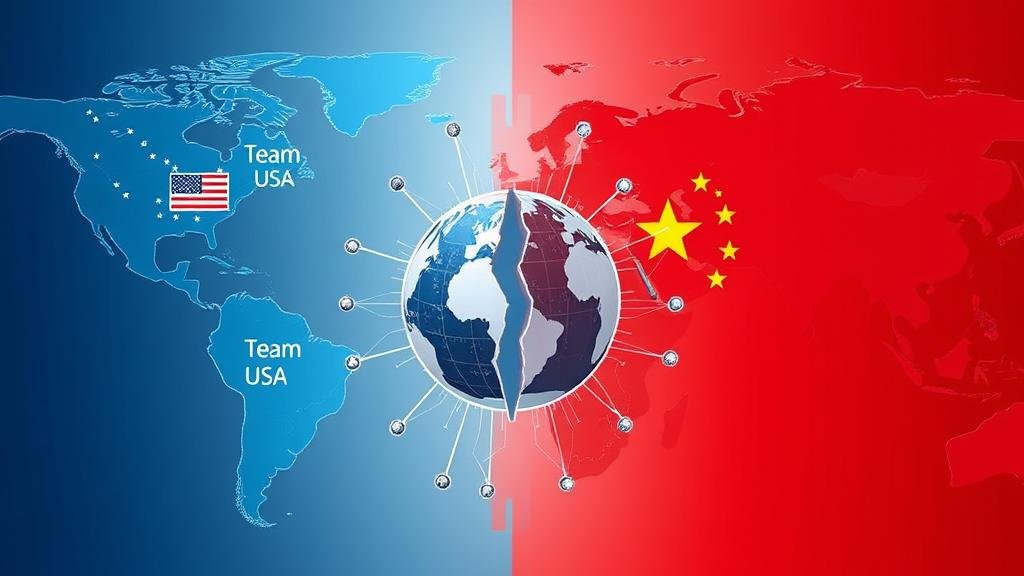
This ongoing regulatory battle is causing a major shift in the global tech landscape. The once-integrated global supply chain, where a chip could be designed in one country, manufactured in another, and assembled in a third, is now fracturing. This has led to the emergence of a “bifurcated” tech world, with two separate ecosystems developing around Team USA and Team China.
This division has several significant implications:
- Increased Costs: A divided supply chain is less efficient, leading to higher costs for consumers.
- Business Uncertainty: Global companies are caught in the middle, navigating competing regulatory environments.
- A Global Chip Race: In response, nations are rushing to build their own chip factories, with initiatives like the U.S. CHIPS Act and the European Chips Act providing billions in government funding.
Welcome to the new era of the tech cold war, where the competition is fought with silicon and strategy.
The Road Ahead: A Marathon, Not a Sprint
Is China on the verge of overtaking its competitors? Not yet. The technological gap remains substantial, particularly in the most advanced areas of semiconductor manufacturing. This is a long-term race, not a short sprint.
However, it would be a mistake to underestimate Beijing’s determination. China has a history of achieving ambitious goals through sheer force of will. The global regulations have not extinguished its ambition; they have only made it more determined.
For businesses and investors, the message is clear: the race for semiconductor supremacy will shape the geopolitical landscape for years to come. Staying informed about the evolving dynamics of the US-China tech war will be just as critical as watching for the latest innovations. This is a defining issue of our time, and its impact will be felt across the globe.