AI Data Centres: Is the Future Small and Decentralized?
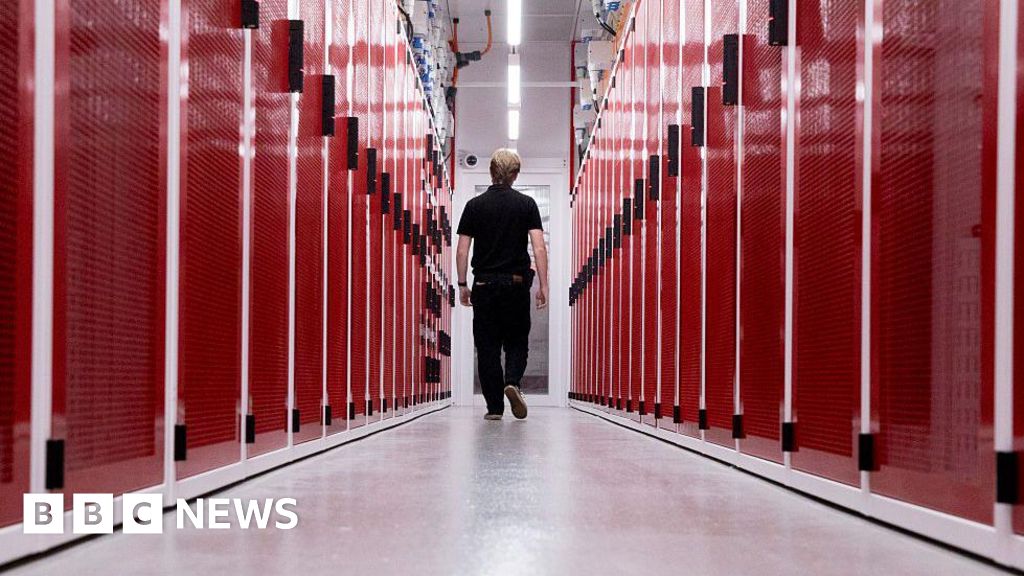
Honey, I shrunk the data centres: Is small the new big?Image Credit: BBC Business (Finance)
Key Points
- •A multi-billion-dollar construction boom is underway to build the massive "AI factories" of the future. Yet a growing chorus of technologists and executives argues that the era of the giant data centre may already be peaking, with a future defined by smaller, decentralised, and even on-device processing power.
- •Apple Intelligence: The tech giant's new AI system performs many functions using specialised chips built into its latest premium iPhones and laptops. Apple cites improved speed and enhanced data privacy as key benefits of this on-device approach.
- •Microsoft Copilot+ PCs: A new line of laptops from Microsoft and its partners also incorporates dedicated hardware for on-device AI processing, enabling features that run locally rather than in the cloud.
- •Innovative Heating: A UK public swimming pool in Devon is being heated by a data centre the size of a washing machine. In another instance, a British couple is using a small data centre in their garden shed to heat their home.
- •Academic Application: University professors have reported using powerful GPUs (Graphics Processing Units) for research, with the heat generated being sufficient to warm their offices.
Honey, I shrunk the data centres: Is small the new big?
A multi-billion-dollar construction boom is underway to build the massive "AI factories" of the future. Yet a growing chorus of technologists and executives argues that the era of the giant data centre may already be peaking, with a future defined by smaller, decentralised, and even on-device processing power.
The Unprecedented AI Boom
The engine of the current artificial intelligence revolution is the data centre. These vast, energy-intensive facilities—packed with powerful computers and specialised chips—are the infrastructure backbone for everything from video streaming and online banking to the generative AI models captivating global markets.
Tech giants are pouring unprecedented capital into their expansion. With an estimated 100 new large-scale data centres under development in the UK alone, and billions being invested globally, the demand appears insatiable. Nvidia CEO Jensen Huang has aptly dubbed them "AI factories," essential for processing the enormous datasets required to train and run advanced AI.
This expansion is driven by a principle known as "scaling," the long-held belief in the AI sector that more computing power directly translates to better AI performance. For investors and corporations, this has meant one thing: build bigger.
A Contrarian Prophecy: The On-Device Future
Despite the current investment frenzy, some industry leaders are predicting a radical shift.
Aravind Srinivas, CEO of AI search firm Perplexity, recently argued that the mighty data centre could eventually be rendered obsolete by the smartphone. His thesis posits that powerful, personalised AI will increasingly run directly on user devices, eliminating the need to send data to and from remote cloud servers.
This is not just a theoretical concept. Early versions are already in the market:
- Apple Intelligence: The tech giant's new AI system performs many functions using specialised chips built into its latest premium iPhones and laptops. Apple cites improved speed and enhanced data privacy as key benefits of this on-device approach.
- Microsoft Copilot+ PCs: A new line of laptops from Microsoft and its partners also incorporates dedicated hardware for on-device AI processing, enabling features that run locally rather than in the cloud.
However, this capability is currently limited to high-end, premium-priced gadgets. "It's long term 'if and when' powerful and efficient AI can run on local devices," notes Jonathan Evans, director of consultancy Total Data Centre Solutions, highlighting that the processing power required by most AI is still far beyond standard consumer equipment.
The Rise of the Micro Data Centre
While the debate between centralised and on-device AI continues, a third model is quietly gaining traction: small, distributed data centres. This approach challenges the notion that computing infrastructure must be a monolithic warehouse.
Pioneering examples are demonstrating a new kind of utility, turning a data centre's primary by-product—heat—into a valuable resource.
- Innovative Heating: A UK public swimming pool in Devon is being heated by a data centre the size of a washing machine. In another instance, a British couple is using a small data centre in their garden shed to heat their home.
- Academic Application: University professors have reported using powerful GPUs (Graphics Processing Units) for research, with the heat generated being sufficient to warm their offices.
Mark Bjornsgaard, whose former company DeepGreen developed the swimming pool project, is a fervent advocate for this model. "Small is definitely the new big," he states. Bjornsgaard envisions a future where every public building houses a small data centre, providing heat as a by-product and networking together to create a powerful, distributed computing grid. "London is just one giant data centre that hasn't been built yet," he says.
Re-thinking Urban and Orbital Infrastructure
This vision of repurposing existing structures is shared by other industry experts. Amanda Brock, CEO of the business organisation OpenUK, believes the centralised model is a "bubble that will burst over time." She suggests that derelict buildings and vacant high-street shops could be repurposed into networks of small data centres.
The push for decentralisation is based on several key advantages:
- Edge Computing: Evans points to the strategic case for "smaller 'edge' data centres near large populations." Placing processing power closer to the end-user dramatically reduces latency, or lag, resulting in faster response times for applications.
- Resource Efficiency: Using the immense heat generated by computing for practical purposes like heating buildings or water addresses major environmental and cost concerns associated with traditional data centres.
Some innovators are looking even further afield. Avi Shabtai, CEO of Ramon Space, is developing orbital data centres. "Space offers a unique opportunity to rethink data structure, where small, scalable data centres in orbit can deliver efficiency, performance and flexibility," Shabtai explains.
The Bottom Line: A Trifurcated Future
The future of data processing is unlikely to be a single solution. Instead, the market appears to be evolving into three distinct but interconnected models.
- The Centralised Core: Massive data centres will remain crucial for the heavy-lifting of training foundational AI models and handling large-scale cloud services. Their role as "AI factories" is secure for the foreseeable future.
- The Intelligent Edge: A growing network of smaller, distributed data centres located closer to users will handle time-sensitive processing, reducing latency for everything from autonomous vehicles to real-time analytics. This represents a significant growth and investment opportunity in urban infrastructure.
- The Personal Device: As chips become more powerful and efficient, on-device AI will become standard, handling personalised tasks, enhancing privacy, and ensuring functionality even without a constant internet connection.
For investors, the landscape is becoming more complex. While the boom in large-scale data centre construction continues, the smart money will also be watching the development of edge computing infrastructure and the chip manufacturers enabling the on-device AI revolution. The question is no longer whether data centres will get bigger, but how they will simultaneously get smaller and closer to us all.
Source: BBC Business (Finance)
Related Articles
ARRY Stock Sinks Despite Market Gains: What to Know
Array Technologies (ARRY) stock declined 2.5% in the latest session, contrasting with market gains. Find out why the solar stock fell and what it means for inve
India and the EU clinch the 'mother of all deals' in a histo
Jay Vine Wins Tour Down Under 2026 After Kangaroo Crash
Australian cyclist Jay Vine secures the overall victory at the 2026 Tour Down Under despite a dramatic final-stage crash involving a kangaroo.
Trump's New Defense Strategy: Allies Must Fund Own Security
The Trump administration's new National Defense Strategy realigns US policy, demanding allies assume primary responsibility for their own security and defense c