How Nvidia’s Gaming GPUs Became the Brains of the AI Revolution
Remember Nvidia? For the longest time, they were the heroes of PC gamers, the wizards behind the curtain making virtual explosions look just a little more *epic*. Their graphics cards, or GPUs, were the stuff of legends. But in a wild plot twist, this gaming-focused company is now powering the entire AI revolution. How did they go from creating beautiful digital dragons to becoming the brains behind the thinking machines of tomorrow? It’s a story of incredible foresight, a dash of genius, and the magic of “parallel processing.” Get ready, because this is the inside scoop on how Nvidia’s AI dominance took the world by storm, leaving other tech giants in the dust.

From Gaming to AI Computing Powerhouse
Let’s rewind to 1993. Nvidia, founded by the visionary trio of Jensen Huang, Chris Malachowsky, and Curtis Priem, had a clear mission: to create the most powerful graphics processing units (GPUs) for PC gaming. Their GeForce cards became iconic, a must-have for anyone serious about high-quality graphics and smooth frame rates. For years, Nvidia was synonymous with gaming, battling it out with competitors for the top spot in graphical performance. But little did we know, a revolution was brewing. The same technology that made our games look so good was about to change the world. The focus on AI computing was not yet on the horizon, but the seeds of AI dominance were sown.
CUDA: The Game-Changing Revelation
In 2006, Nvidia unveiled its secret weapon: CUDA. This wasn’t just another piece of software; it was a revolutionary platform that allowed developers to harness the immense parallel processing power of GPUs for general-purpose computing. Suddenly, the same hardware that rendered ultra-realistic gaming environments could be used for complex calculations in scientific research, data analysis, and, most importantly, artificial intelligence. This was the turning point. The thinking machine was born, and the world of AI computing would never be the same. CUDA became the foundation for a new era of deep learning frameworks.
Nvidia’s AI Dominance and the Rise of Large Language Models
The AI revolution exploded in the early 2010s with the advent of deep learning and neural networks. Training these new AI models, the technology behind today’s chatbots and self-driving cars, demanded an unprecedented amount of computational power. And who was perfectly poised to provide it? Nvidia. Their GPUs, powered by CUDA, were the ideal tools for the job. AI researchers and developers began buying up AI GPUs at an incredible rate. Nvidia capitalized on this surge in demand, perfecting its AI infrastructure and solidifying its position as the undisputed leader in the AI hardware market. Their strategic foresight and innovative Nvidia marketing strategies paid off, resulting in unparalleled AI dominance. This was the era of large language models and Nvidia was at the heart of it.
The Meteoric Rise of Nvidia Stock and the Trillion-Dollar Club
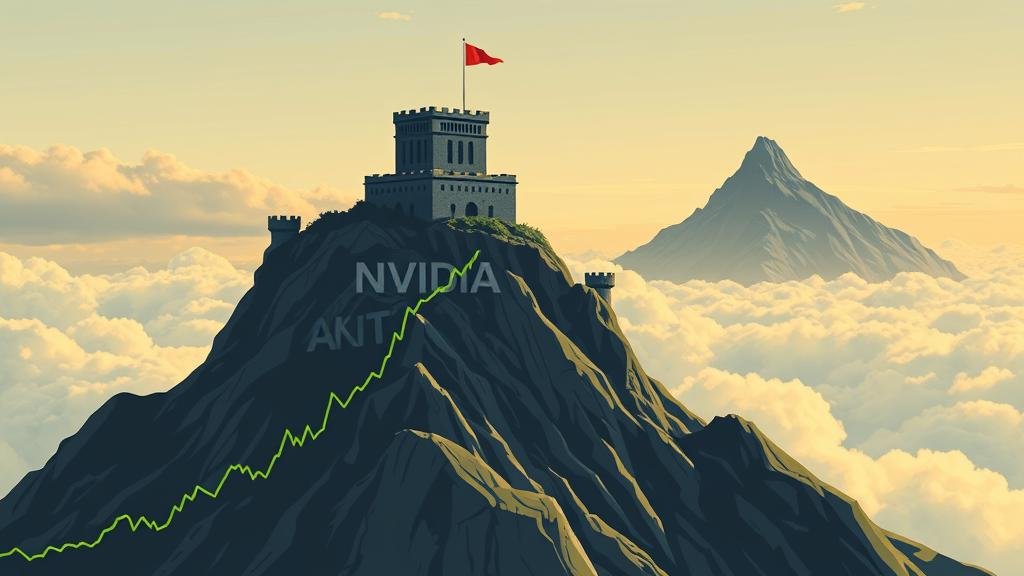
The result? A meteoric rise in Nvidia stock. The company’s value skyrocketed, propelling it into the exclusive trillion-dollar club and making it one of the most valuable corporations in the world. This wasn’t just market hype; it was a reflection of the insatiable demand for their powerful AI chips. Nvidia had become the engine behind the generative AI boom, powering the large language models that are reshaping our world.
The Future of AI Dominance: The Blackwell Platform and Beyond
Nvidia’s journey is a testament to their long-term vision. But with great success comes great competition. Can they maintain their AI dominance? Nvidia is not resting on its laurels. With the introduction of the even more powerful Blackwell platform, they are pushing the boundaries of what’s possible in AI computing. The story of the thinking machine is far from over. It’s a story of how a company that started with a passion for gaming ended up building the future of artificial intelligence. The legacy of Jensen Huang and his team continues to unfold.