Navigating the Ripple Effect: Japan, China, and the U.S. Face a Taiwan Contingency
Recent statements from Tokyo regarding Taiwan have escalated tensions with Beijing, prompting Japan to seek stronger assurances from the United States. This situation highlights the evolving security dynamics in the Indo-Pacific and the critical importance of the U.S.-Japan alliance.
The Catalyst: A Shift in Japan’s Defense Posture
The current friction began when Japanese Prime Minister Sanae Takaichi suggested that a Chinese attack on Taiwan would constitute a “threat to Japan’s survival.” This statement is significant because of Japan’s post-WWII constitution, which renounces war. However, a 2015 reinterpretation allows for “collective self-defense,” enabling Japan to defend an ally under attack.
Takaichi’s comment was the first time a Japanese leader explicitly linked this concept to a Taiwan contingency. For Beijing, which views Taiwan as a renegade province, this was a provocative move, signaling a potential shift in Japan’s defense policy and a challenge to China’s military assertiveness.
Japan’s Strategic Interests in the Taiwan Strait
Japan’s concerns about Taiwan are rooted in several key strategic factors:
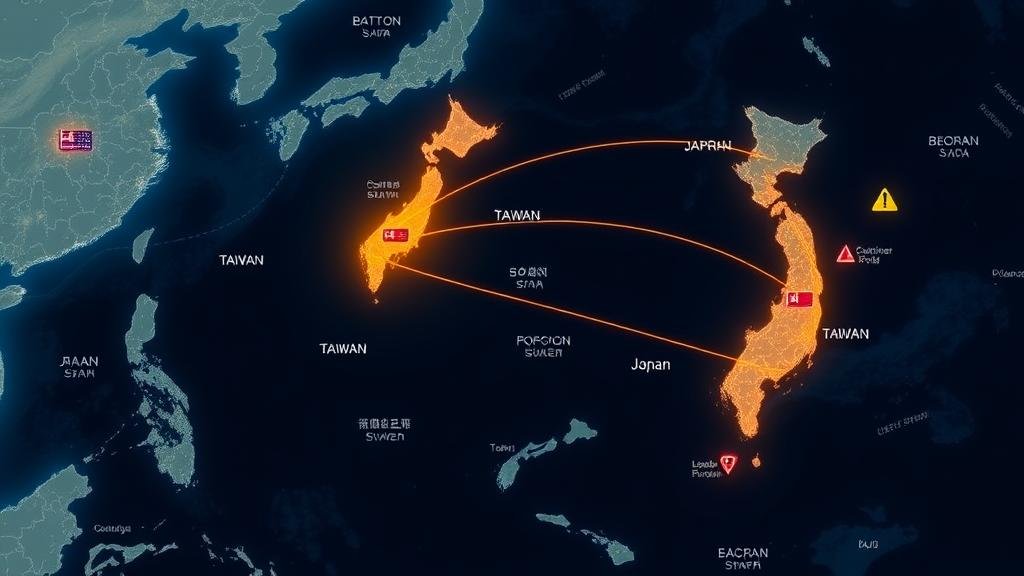
- Geographic Proximity: Japan’s southwestern islands are geographically close to Taiwan. Any conflict in the Taiwan Strait could easily spill over, posing a direct threat to Japanese territory and citizens.
- Economic Security: The Taiwan Strait is a vital sea lane for Japan, with a significant percentage of its energy supplies and trade passing through it. A blockade or conflict in this area would severely disrupt Japan’s economy, making “economic de-risking” from China a more pressing issue.
- Shared Democratic Values: Japan and Taiwan are both key democracies in a region increasingly dominated by authoritarian powers. The fall of a democratic Taiwan to an assertive China would set a dangerous precedent and undermine the regional “rules-based international order.”
Beijing’s Response: Diplomatic and Economic Pressure
China’s reaction was swift and multifaceted. Diplomatically, it involved summoning Japan’s ambassador for a reprimand. Economically, China issued a travel advisory for Japan, a tactic designed to inflict economic pain and signal its displeasure. This underscores the Chinese Communist Party’s sensitivity to any form of foreign military involvement in what it considers its internal affairs.
Tokyo’s Appeal to Washington: A Call for Strategic Clarity
Facing pressure from Beijing, Japan has reportedly urged the United States to adopt a more vocal and unambiguous stance in its support. This is a significant development, as Japan is essentially asking the U.S. to move away from its long-standing policy of “strategic ambiguity” on Taiwan.
Japan seeks this for several reasons:
- Alliance Solidarity: Tokyo wants to ensure the U.S.-Japan alliance is robust enough to withstand China’s “gray zone” tactics—coercive actions that fall short of outright war.
- Deterrence: Japan believes that a stronger, clearer U.S. position will deter Chinese aggression by raising the political and military costs of a Taiwan invasion.
- Narrative Warfare: Japan wants U.S. help in shaping the global narrative, framing China as the aggressor and the U.S.-Japan alliance as a force for regional stability.
The U.S. Dilemma and Regional Implications
This puts the U.S. in a difficult position. A move toward “strategic clarity” could be seen as a provocation by China, potentially escalating tensions. However, maintaining ambiguity may no longer be sufficient to deter an increasingly confident Beijing.
The entire Indo-Pacific region is watching closely. The heightened tensions could lead to a regional arms race and accelerate economic “de-risking.” It also puts alliances like the Quad (U.S., Japan, Australia, India) to the test.
Ultimately, Washington’s decision on whether to maintain strategic ambiguity or move toward strategic clarity will have profound consequences for the future of Taiwan, the U.S.-Japan alliance, and the entire Indo-Pacific security landscape.