Modern Greece vs. Ancient Greece: Has the Nation Betrayed Its Past?

The Weight of a Glorious Past
Imagine being the less-famous sibling of a global superstar. Your whole life, at every family reunion, someone sidles up and says, “So, when are you going to write a rock anthem like your brother Sylvester? ‘Eye of the Tiger’ was a classic.” Sounds exhausting, right?
Let’s be real: this is basically modern Greece’s entire existence. The nation is constantly being compared to its ridiculously overachieving ancestor, Ancient Greece. We’re talking about the Golden Age that gave us democracy, philosophy, and plays that are still making high school students groan. Talk about pressure. As one Washington Post writer put it, “Modern Greece’s real problem? Ancient Greece.”
So when modern Greece hits a rough patch—like, say, a sovereign debt crisis that makes your credit card bill look cute—the critics pounce. “Betrayal!” they screech. “They’ve squandered their inheritance!”
Cue dramatic pause.
This take ignores the absolute rollercoaster of Greek history & civilization since Pericles was in charge. We’re talking Roman conquest, 400 years of Ottoman rule, a brutal war for independence, a couple of world wars, a nasty civil war, and a military junta for good measure. Expecting Greece to pop out of that historical trauma conga line looking like a serene, toga-clad philosopher is, well, a choice.
The takeaway: Judging Greece for not being Ancient Greece is like getting mad at your adult child for not being as cute as their baby pictures. It’s a little weird, and you’re missing the point.
The Unbroken Thread: Language and Culture
“But the culture is gone!” some might cry. To which I say: have you ever tried to learn Greek?
While the language has obviously evolved (thankfully, or they’d still be carving everything in stone), the link between ancient and modern Greek is shockingly strong. A study of the similarities & differences reveals a clear lineage. The language platform Preply compares it to the relationship between Old English and the stuff we speak today. Distinct, but you can see the family resemblance.
This isn’t just a fun fact for language nerds. It’s a living, breathing connection to the past. It’s the cultural software that’s never been wiped clean; it just got a few thousand years of updates.
And it goes beyond language. That spirit of philotimo—a uniquely Greek super-word for a mix of honor, duty, and hospitality—is still kicking. It’s the driving force behind a stranger insisting you have a fifth piece of baklava. The threads are still there, woven into the very fabric of life.
The lesson for today: The soul of the country didn’t get lost in translation. It just learned some new words.
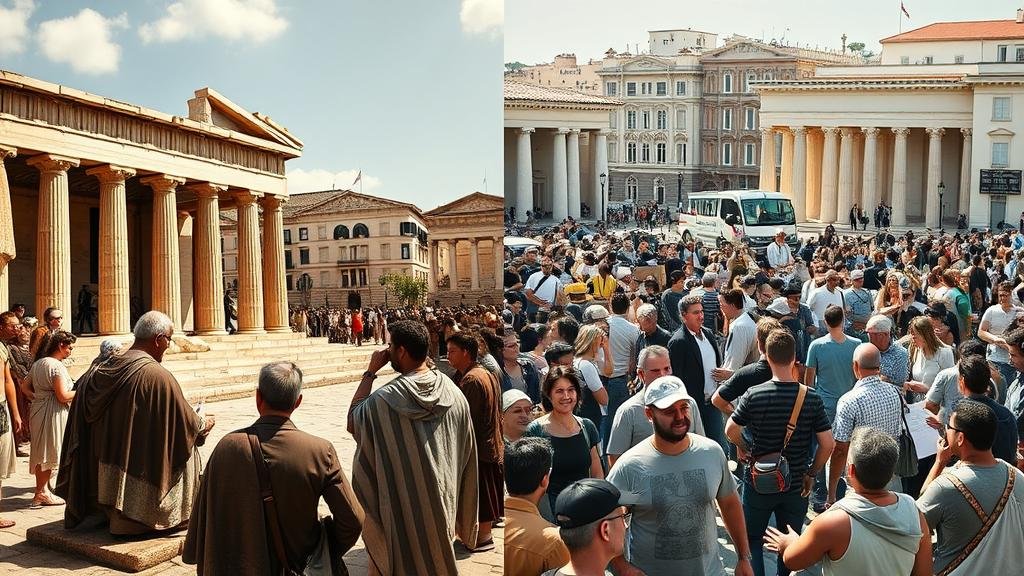
Democracy’s Tumultuous Journey
Okay, let’s talk about the elephant in the agora: the political drama. One of the biggest accusations in the Modern Greek vs. Ancient Greek debate is that the nation has failed its democratic ideals. The corruption! The instability!
Gasp!
The birthplace of democracy having messy politics? Unheard of!
Here’s the thing: Ancient Athenian democracy was a hot mess, too. And let’s not forget it was an exclusive club. Women, slaves, and foreigners weren’t invited to the party. It was less “power to the people” and more “power to some of the dudes.”
Modern Greece’s loud, passionate, protest-heavy politics isn’t a betrayal of its roots; it’s a continuation of them. The shouting, the debating, the endless arguments over coffee—that is the democratic spirit. It’s not a bug, it’s a feature.
Worth noting on the final exam: Democracy isn’t a perfect system you inherit. It’s a fixer-upper you have to keep working on, and the renovations are always loud.
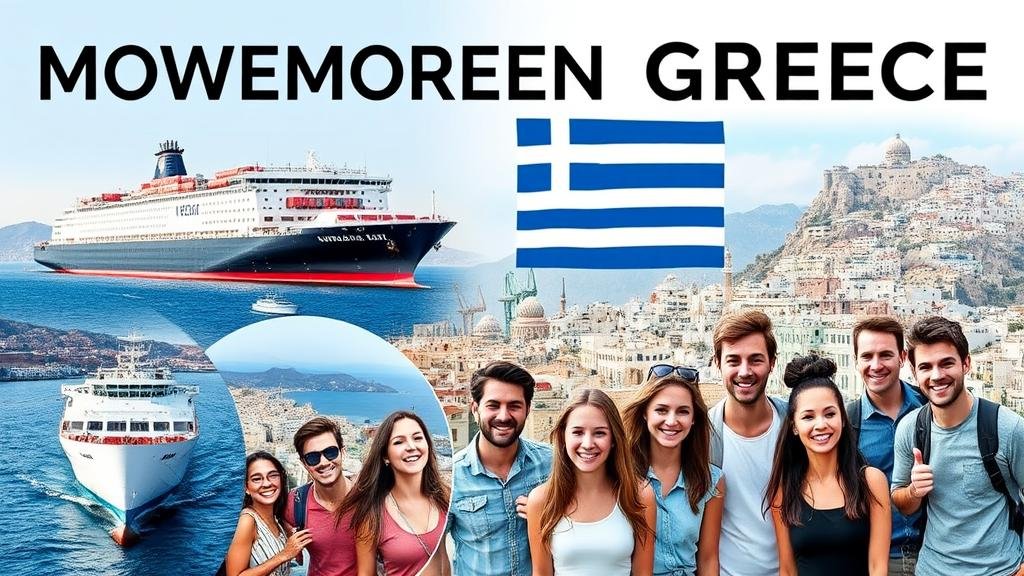
Beyond the Parthenon: A Modern, Vibrant Nation
Hot take: To see Greece as just an open-air museum is to miss the whole show. Turns out, modern Greece is actually… really good at stuff.
For starters, they’re a global powerhouse in shipping. Greek shipowners control the largest merchant fleet on Earth. Their tourism industry welcomes millions of people who come for the history and stay for the feta. And a new generation of Greek artists, thinkers, and scientists are making waves worldwide.
But the most impressive part? Resilience. Remember that whole crippling financial crisis? The Greek people weathered that storm with a level of grit and solidarity that’s genuinely inspiring. They faced it, they fought through it, and they’re still standing.
In summary: It’s a nation, not a monument. And frankly, the nation is way more interesting.
A More Nuanced Perspective
So, where does that leave us? Judging a country by its 2,500-year-old highlight reel isn’t just unfair; it’s lazy. It stops us from seeing the complex, tough, and beautiful reality of modern Greece.
Modern Greece hasn’t betrayed its past. It has carried it—on its back, through centuries of hardship, like the world’s most historically significant marathon runner.
The spirit of ancient Greece doesn’t live in crumbling marble. It lives in fiery political debates, in ship captains navigating the globe, and in the grandmother who won’t let you leave her house hungry. The next time you hear someone weighing Modern Greece vs. Ancient Greek achievements, you’ll have the full story.
And yes, this will be on the test.