Muhoozi Kainerugaba's Rise & Uganda's Economic Risk
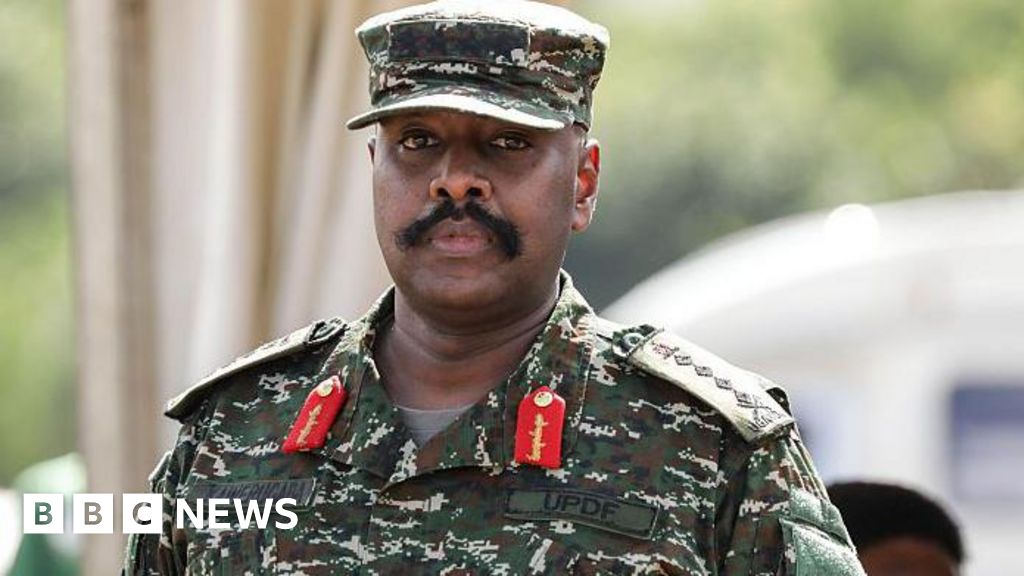
Muhoozi Kainerugaba: Uganda's army chief who threatened to castrate Bobi WineImage Credit: BBC News
Key Points
- •KAMPALA, UGANDA – A carefully orchestrated, yet publicly volatile, succession plan is unfolding in Uganda, creating significant uncertainty for one of East Africa's key economies. As President Yoweri Museveni, in power since 1986, paves the way for his son, General Muhoozi Kainerugaba, investors and international partners are watching with growing apprehension. The potential transition from a long-serving autocrat to his controversial heir is fraught with political risk, casting a long shadow over the nation's economic stability and future investment climate.
- •Military Career: Kainerugaba joined the UPDF in 1999 and received training at elite military academies, including Sandhurst in the UK and Fort Leavenworth in the US. His promotions have been extraordinarily rapid, culminating in his current role as the head of the entire Ugandan military.
- •Controversial Rhetoric: He famously threatened to "capture Nairobi" in under two weeks, forcing his father to issue a public apology to Kenya. He has also engaged in vitriolic attacks on opposition figures, including a widely condemned threat to "castrate" musician-turned-politician Bobi Wine.
- •Political Ambitions: Despite being a serving military officer, which legally bars him from partisan politics, Kainerugaba has held nationwide rallies and birthday celebrations that function as campaign events, effectively launching his bid for the 2026 presidential election.
- •Investor Confidence: Foreign Direct Investment (FDI) is sensitive to political instability. A contested or violent succession could trigger capital flight and deter new investment in critical sectors like oil, agriculture, and infrastructure.
Here is the complete news article in markdown format.
Uganda's Succession Saga: Economic Jitters Mount as Museveni's Son Eyes Presidency
KAMPALA, UGANDA – A carefully orchestrated, yet publicly volatile, succession plan is unfolding in Uganda, creating significant uncertainty for one of East Africa's key economies. As President Yoweri Museveni, in power since 1986, paves the way for his son, General Muhoozi Kainerugaba, investors and international partners are watching with growing apprehension. The potential transition from a long-serving autocrat to his controversial heir is fraught with political risk, casting a long shadow over the nation's economic stability and future investment climate.
General Kainerugaba, the current Chief of Defence Forces, is not a subtle political operator. His aggressive rhetoric, often delivered via the social media platform X (formerly Twitter), has included threats to invade neighboring Kenya and violent warnings to political opponents. These outbursts, combined with his rapid and unorthodox rise through the military, paint a portrait of a leader whose temperament is causing jitters in boardrooms from London to Beijing. The so-called "Project Muhoozi" is no longer a backroom whisper; it is a public spectacle with profound economic implications.
The General's Ascent: A Profile in Power
General Kainerugaba's career has been inextricably linked to his father's presidency. He has moved swiftly through the ranks of the Uganda People's Defence Forces (UPDF), holding key command positions that have given him control over the nation's most powerful security apparatus. While his supporters see a strong leader prepared to maintain stability, critics and investors see a pattern of volatility and a consolidation of power that undermines democratic and economic institutions.
His public persona only amplifies these concerns. The general's digital footprint is a catalogue of diplomatic incidents and domestic threats, which analysts argue could signal a highly unpredictable presidency.
-
Military Career: Kainerugaba joined the UPDF in 1999 and received training at elite military academies, including Sandhurst in the UK and Fort Leavenworth in the US. His promotions have been extraordinarily rapid, culminating in his current role as the head of the entire Ugandan military.
-
Controversial Rhetoric: He famously threatened to "capture Nairobi" in under two weeks, forcing his father to issue a public apology to Kenya. He has also engaged in vitriolic attacks on opposition figures, including a widely condemned threat to "castrate" musician-turned-politician Bobi Wine.
-
Political Ambitions: Despite being a serving military officer, which legally bars him from partisan politics, Kainerugaba has held nationwide rallies and birthday celebrations that function as campaign events, effectively launching his bid for the 2026 presidential election.
"Project Muhoozi": A High-Stakes Economic Gamble
The unofficial campaign to install Kainerugaba as the next president is a dynastic project that carries substantial economic risk. The rhetoric from his supporters often borders on the surreal, illustrating the cult of personality being constructed around the first family. In one widely reported instance, a government minister articulated the movement's quasi-religious fervor.
"We believe in God the Father - and God the Father is President Museveni. God the Son is MK [Muhoozi Kainerugaba], and now you [the voters] are the Holy Spirit. Therefore, vote for them," she was quoted as saying.
Such statements, while dismissed by some, underscore a political environment where personal loyalty trumps institutional process—a major red flag for capital markets that rely on the rule of law.
-
Investor Confidence: Foreign Direct Investment (FDI) is sensitive to political instability. A contested or violent succession could trigger capital flight and deter new investment in critical sectors like oil, agriculture, and infrastructure.
-
Institutional Decay: The focus on a dynastic handover weakens state institutions, including the judiciary, the electoral commission, and the central bank. When power is personalized, regulatory and legal frameworks become less reliable, increasing the cost and risk of doing business.
-
Risk of Sanctions: Kainerugaba's documented aggression and the potential for a violent crackdown on dissent place Uganda at risk of international sanctions. Such measures could target key officials and economic sectors, isolating the country from global financial markets.
The Army's Expanding Economic Empire
Underpinning Kainerugaba's power is the UPDF's significant and growing role in the Ugandan economy. The military is not just a security force; it is a major commercial actor. As its commander, General Kainerugaba wields immense economic influence, blurring the lines between national security and commercial enterprise.
The National Enterprise Corporation (NEC), the commercial arm of the UPDF, has become a dominant player in numerous industries. This arrangement raises serious questions about fair competition and transparency.
-
Key Holdings: The NEC operates in sectors including construction, manufacturing, agriculture, and healthcare. It is often awarded large government contracts without competitive bidding, crowding out private sector players.
-
Control of Infrastructure: The military has been increasingly deployed to oversee major infrastructure projects, including those related to Uganda's nascent oil industry. This gives the army, and by extension its commander, direct control over the nation's most valuable future assets.
-
Lack of Transparency: The NEC's finances are largely opaque. As a military entity, it is not subject to the same level of public or parliamentary scrutiny as private companies or other state-owned enterprises, creating a high risk for corruption.
The Road to 2026: A Volatile Outlook
As Uganda approaches the 2026 general election, the economic and political landscape is set to become more turbulent. The opposition, though fractured and repressed, remains a potent force, with figures like Bobi Wine commanding significant popular support. Any attempt to sideline them through force would likely lead to widespread unrest.
International lenders and development partners, including the World Bank and IMF, are in a difficult position. They have poured billions into Uganda but are now faced with a succession plan that runs counter to principles of good governance. Their future lending decisions will be a key indicator of international sentiment.
For Uganda, the path forward is uncertain. The key question for the market is whether "Project Muhoozi" can deliver a stable, albeit authoritarian, continuity, or whether it will unleash a period of instability that unravels decades of economic progress. For now, the risk premium on Uganda is rising, and the world is watching to see if the son's rule will be a continuation of the father's playbook or a far more volatile and dangerous chapter.
Source: BBC News
Related Articles
Nationwide Protests Against ICE Enforcement Erupt in U.S.
Thousands are protesting ICE after the DOJ declined to investigate a fatal agent-involved shooting in Minneapolis, fueling a national movement and public anger.
ARRY Stock Sinks Despite Market Gains: What to Know
Array Technologies (ARRY) stock declined 2.5% in the latest session, contrasting with market gains. Find out why the solar stock fell and what it means for inve