The End of Reality: How to Restore Digital Trust in the Age of AI
Ever scroll through a social media feed and feel like you’re the only one not living a picture-perfect life? Flawless photos, consistently clever captions, and a posting schedule that seems almost… robotic.
If your intuition is screaming, “Something’s off!”—you’re right. The internet is becoming a funhouse of mirrors, and we’re all struggling to find a reflection of reality. Welcome to the new age of digital trust, or the lack thereof.

What was once a promise of a global library is now a chaotic digital landscape. It’s a minefield of fake accounts, dangerously inadequate content moderation, and an ever-growing army of AI writers. This toxic combination is eroding our ability to trust what we see and read online. A society that can’t agree on a shared reality is a society in peril. It’s like trying to build a house on quicksand.

The Age of Imposters: You’re Not Arguing with a Person
That heated online debate you’re in about pineapple on pizza? You might be arguing with a sophisticated bot designed to stoke outrage for engagement. These are not your grandparents’ spam bots. These are advanced networks of fake accounts, meticulously crafted to mimic human behavior. They can artificially inflate a political candidate’s popularity, manipulate markets, and sow discord—all while remaining undetected.
As the New York Times has reported, social media platforms have been slow to act, and the problem has metastasized. These digital phantoms are the front line in the erosion of digital trust, paving the way for more significant threats by leaving us exhausted and paranoid.
The Alarming Impact of Digital Phantoms
- Superspreaders of Misinformation: Coordinated bot networks can make a lie trend globally in minutes.
- Financial Scams on a Massive Scale: They lure you with promises of quick riches, only to drain your pockets.
- Drowning Out Authentic Voices: Genuine human connection is lost in an overwhelming sea of automated noise.
The Overwhelmed Moderator: A Losing Battle
Why don’t platforms simply delete harmful content? The sheer volume of it is staggering. With millions of posts, photos, and videos uploaded every minute, content moderation is an impossible task. This is the reality of “lax moderation”—a system that is fundamentally broken.
Automated filters often lack the nuance to distinguish between genuine journalism and extremist propaganda. A 2022 analysis on Verfassungsblog highlighted that moderating extremist content is inherently “prone to error.” This leads to two disastrous outcomes:
- Harmful Content Remains: Dangerous ideologies and conspiracy theories slip through the cracks, radicalizing vulnerable individuals.
- Important Voices Are Silenced: Crucial information from journalists and activists gets mistakenly flagged and removed.
The Synthetic Nightmare: Seeing and Reading Are No Longer Believing
Welcome to the final boss of fake news: Generative AI. We now have AI tools that can write articles, create photorealistic images of events that never occurred, and generate deepfake videos of people saying things they never said. This is no longer science fiction; this is our new reality.
Tools like ChatGPT can produce human-sounding blog posts, while image generators can create a believable photo of a world leader in a compromising situation. Deepfake technology means that even a video of a CEO confessing to fraud could be a complete fabrication. When anything can be faked, the motivation to seek the truth plummets.
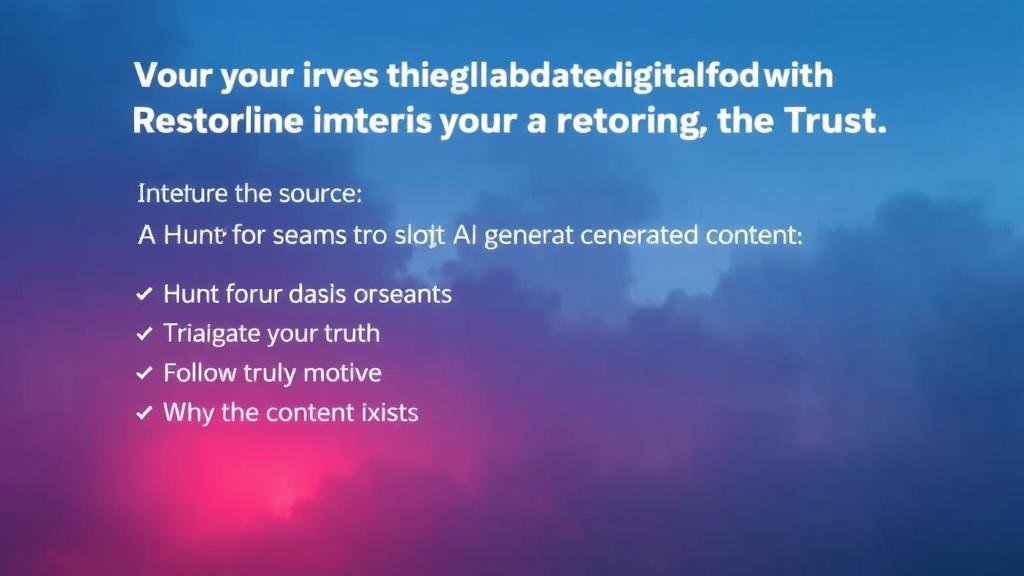
Your Guide to Navigating the Digital Fog and Restoring Trust
So, what can we do? We can’t afford to be passive. We must all become more discerning consumers of information. Think of it as developing a new superpower: a highly attuned baloney detector.
1. Interrogate the Source: E-E-A-T Is Everything
In the new era of Generative Engine Optimization (GEO), expertise, experience, authoritativeness, and trustworthiness (E-E-A-T) are paramount. Before you share, ask: Who is the author? Do they have a reputable history? Or is it an anonymous account with no credibility? Be skeptical.
2. Hunt for the Seams: Spotting AI-Generated Content
AI is good, but it’s not perfect—yet. Look for the tell-tale signs. AI text can feel repetitive and soulless. AI images might have subtle flaws, like a person with six fingers or an unnatural skin texture. Sharpening this skill is the new digital literacy.
3. Triangulate Your Truth: The Power of Multiple Sources
Never rely on a single source, especially for significant news. If you see something shocking, verify it with multiple reputable news outlets. If only a single obscure website is reporting it, it’s likely not true.
4. Follow the Money and Motive: Why Does This Content Exist?
Consider the motive behind the content. Is it trying to provoke an emotional reaction? Content designed to trigger outrage is often designed to bypass your critical thinking. Understanding the motive will help you see the message for what it truly is.
The digital world is at a tipping point. The convergence of imposters, overwhelmed platforms, and powerful AI has created a perfect storm for the erosion of digital trust. It’s on all of us—platforms, creators, and consumers—to fight back. The future of our shared reality depends on it.