SpaceX vs. OpenAI: The $800 Billion Grudge Match
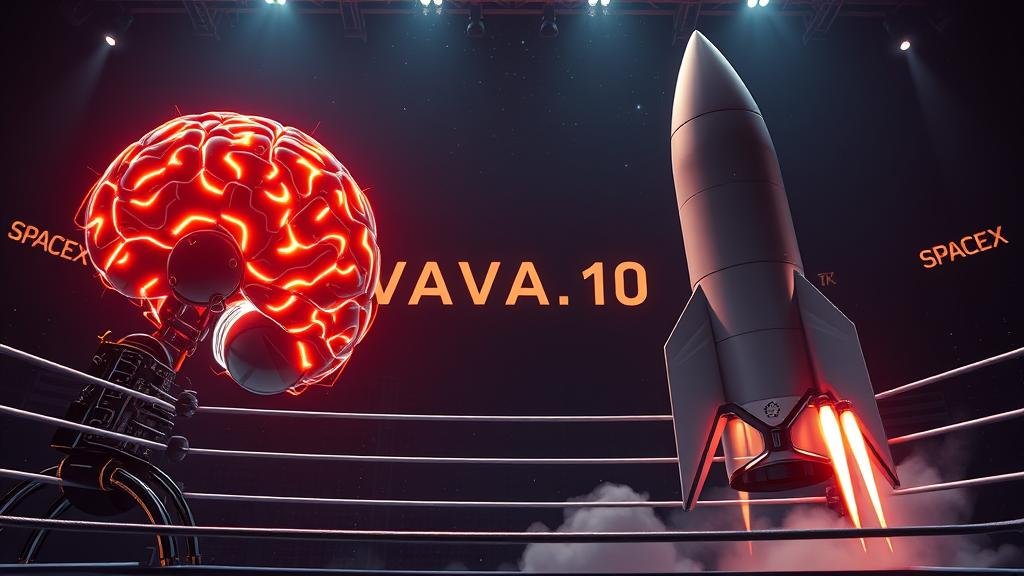
In the high-stakes arena of tech valuations, where titans are made and unmade, the heavyweight title fight just got a new twist. For a moment, it seemed OpenAI and its paradigm-shifting ChatGPT were the undisputed champions. But new reports suggest Elon Musk’s SpaceX is preparing an uppercut.
While OpenAI recently made headlines with a staggering $500 billion valuation, sources indicate SpaceX is orchestrating a secondary share sale aiming for a colossal $800 billion valuation. This isn’t just a business transaction; it’s a bold-faced challenge, a cosmic statement that says, “Your AI is impressive, but we’re building the interplanetary future.”
This is the updated tale of two titans: the master of the digital mind versus the master of metal and fire.
Understanding the Multi-Billion Dollar Valuations
A “secondary share sale” might sound like Wall Street jargon, but it’s the key to this drama. Instead of a public IPO, this is a private event where existing shareholders, like the engineers who fuel the company with their brilliance, can sell their shares to a select group of investors.
This maneuver accomplishes two things:
- Rewards the Team: It allows early employees to cash in on their hard-earned equity.
- Sets a New Benchmark: The price paid in these sales establishes a new, unofficial valuation for the company, sending a powerful signal to the market about investor confidence.
For SpaceX to aim for $800 billion, its foundation must be rock-solid. It’s built on three powerful pillars.
Pillar 1: Dominance in the Cosmos with the Falcon 9

At its heart, SpaceX has revolutionized space travel. Its launch business, powered by the incredibly reliable and reusable Falcon 9 rocket, is the company’s profitable engine. The Falcon 9 is the go-to launch vehicle for a diverse range of clients:
- Corporate Contracts: Telecom and data companies rely on SpaceX to deploy their satellites.
- Government Partnerships: NASA trusts SpaceX for missions to the International Space Station.
- National Security: The U.S. Space Force uses the Falcon 9 for critical launches.
This launch dominance provides the financial bedrock for SpaceX’s more audacious projects.
Pillar 2: Starlink – Connecting the Globe from Orbit
If the launch business is the steady gig, Starlink is the disruptive side hustle turned primary growth driver. Starlink is SpaceX’s ambitious initiative to deliver high-speed internet to every corner of the globe via a constellation of thousands of satellites.
With over 2 million customers and a rapidly growing network, Starlink is already a major force, serving markets from rural homes to airlines and cruise ships. For many investors, Starlink’s potential to become a global telecom giant is the real story, justifying a valuation that reaches for the stars.
Pillar 3: Starship – The Audacious Bet on a Multi-Planetary Future

Starship is the magnificent, stainless-steel vessel designed to take humanity to Mars. While still in its test phases, it represents a quantum leap in space exploration. If Starship succeeds, it unlocks a new economic frontier:
- Point-to-Point Earth Travel: Imagine flying from New York to London in under an hour.
- Rapid Satellite Deployment: Launching hundreds of Starlink satellites at once.
- Building on the Moon and Mars: Owning the transportation infrastructure for an interplanetary economy.
Starship represents the high-risk, high-reward gamble that inflates the company’s valuation into the stratosphere.
The Tale of Two Titans: SpaceX vs. OpenAI
So we have an epic showdown. In one corner, OpenAI, an all-powerful digital brain in the cloud, its value rooted in algorithms and the AI revolution. In the other, SpaceX, a master of physics and hardware, its value in factories, rockets, and tangible infrastructure.
The fact that the hardware-heavy SpaceX is aiming to surpass the software-centric OpenAI highlights a fascinating dynamic. It shows that while investors are captivated by the promise of AI, there remains a profound respect for building the massive, world-changing hardware that will define our future.
It’s a powerful reminder that while software may be “eating the world,” you can’t code your way to Mars. As this valuation battle unfolds, we’re witnessing a clash of two incredible visions for humanity’s future. The winner won’t just be a company; it will be a signal of where we’re headed next. 🚀