Starmer in Beijing for UK Trade & Investment Talks
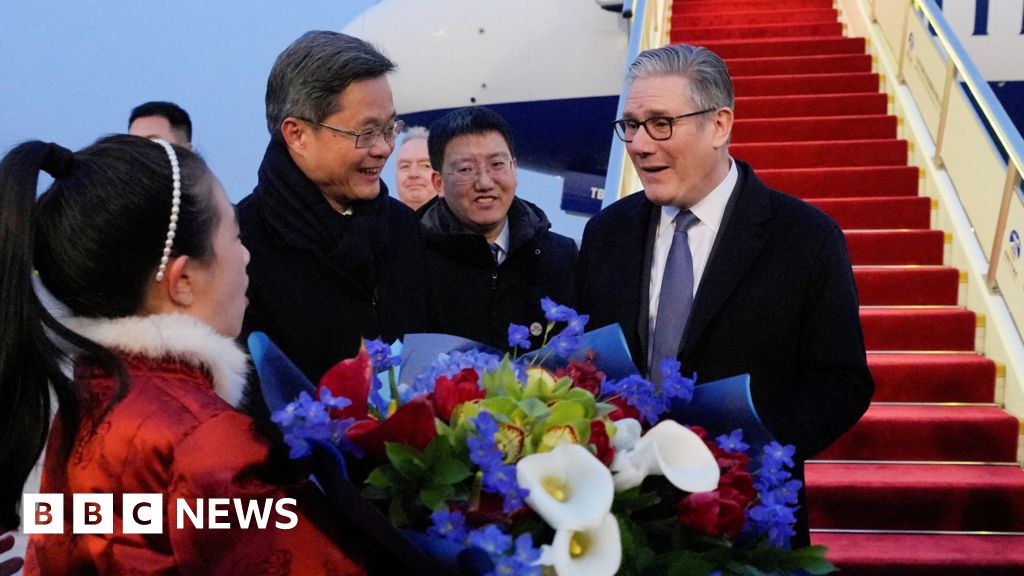
China trip will bring benefits to UK, Starmer insists, as he lands in BeijingImage Credit: BBC Politics
Key Points
- •BEIJING – Prime Minister Keir Starmer arrived in the Chinese capital today, defending his diplomatic mission as essential for Britain's economic prosperity while facing a torrent of criticism at home over national security and human rights.
- •Trade Expansion: The primary goal is to address the UK's significant trade deficit with China and open new avenues for British exports, particularly in high-value sectors like financial services, automotive, and pharmaceuticals.
- •Investment Opportunities: The trip aims to attract Chinese investment into UK infrastructure and green technology projects, with the government stressing that all investments will be subject to rigorous scrutiny under the National Security and Investment Act.
- •Global Cooperation: Downing Street has also highlighted the necessity of engaging with Beijing on transnational issues like climate change, global health security, and economic stability, arguing that no meaningful progress can be made without China's participation.
- •Human Rights Concerns: Opponents point to the ongoing imprisonment of British national and pro-democracy publisher Jimmy Lai in Hong Kong, the systemic persecution of the Uyghur minority in Xinjiang—which several parliaments have labelled a genocide—and the broader crackdown on civil liberties.
China trip will bring benefits to UK, Starmer insists, as he lands in Beijing
BEIJING – Prime Minister Keir Starmer arrived in the Chinese capital today, defending his diplomatic mission as essential for Britain's economic prosperity while facing a torrent of criticism at home over national security and human rights.
The Prime Minister's visit, the first by a UK leader in over five years, is framed by the government as a pragmatic effort to re-engage with the world's second-largest economy. Downing Street insists the trip will unlock trade and investment opportunities crucial for UK growth.
However, the visit is fraught with political risk. It unfolds against a backdrop of deeply strained bilateral relations and sharp condemnation from opposition parties and human rights groups, who accuse the government of sacrificing principles for profit.
The Government's Economic Gambit
The core objective of the Prime Minister's delegation is economic. The government argues that for a post-Brexit "Global Britain" to succeed, it cannot afford to ignore a market of 1.4 billion people. The focus is on securing tangible outcomes for British businesses.
Officials travelling with the Prime Minister have outlined a multi-pronged economic agenda.
- Trade Expansion: The primary goal is to address the UK's significant trade deficit with China and open new avenues for British exports, particularly in high-value sectors like financial services, automotive, and pharmaceuticals.
- Investment Opportunities: The trip aims to attract Chinese investment into UK infrastructure and green technology projects, with the government stressing that all investments will be subject to rigorous scrutiny under the National Security and Investment Act.
- Global Cooperation: Downing Street has also highlighted the necessity of engaging with Beijing on transnational issues like climate change, global health security, and economic stability, arguing that no meaningful progress can be made without China's participation.
A Chorus of Criticism at Home
The Prime Minister’s economic rationale has failed to quell fierce opposition in Westminster. Critics argue the visit projects weakness and legitimises a regime accused of gross human rights violations and hostile actions against the UK.
The Liberal Democrats have been among the most vocal opponents. Deputy leader Daisy Cooper articulated the deep-seated concerns, stating, "Whilst the Chinese regime still holds British citizen Jimmy Lai captive in prison, and whilst the Chinese regime continues to hunt down pro-democracy protesters on the streets of Britain with bounties on their heads, the British prime minister has gone cap in hand to China."
The criticism centres on three key areas:
- Human Rights Concerns: Opponents point to the ongoing imprisonment of British national and pro-democracy publisher Jimmy Lai in Hong Kong, the systemic persecution of the Uyghur minority in Xinjiang—which several parliaments have labelled a genocide—and the broader crackdown on civil liberties.
- National Security Risks: There are acute fears about Chinese espionage and influence operations on UK soil. The recent bounties placed on Hong Kong activists residing in Britain have amplified these concerns, leading to questions about the government's priorities.
- Geopolitical Messaging: Critics argue the visit undermines the UK's standing with key allies, particularly the United States, which has adopted a more hawkish stance towards Beijing. They fear it signals a willingness to de-prioritise security and values-based alliances in favour of economic expediency.
The 'Super-Embassy' Controversy
A specific flashpoint in the security debate is the planned new Chinese embassy in London. Daisy Cooper’s comments referenced the "promise of a super-embassy from which the Chinese regime will continue to spy on us."
This refers to the controversial proposal for China to build its largest European embassy on the site of the former Royal Mint, near the Tower of London. The project has faced significant local opposition and warnings from security experts and politicians about the potential for it to become a hub for intelligence gathering in the heart of the capital. The government's perceived accommodation of this plan is seen by critics as a major concession.
Navigating a Complex Relationship
This high-stakes visit marks a pivotal moment in the UK's evolving China strategy. It represents a calculated departure from the more confrontational rhetoric of recent years, which saw relations plummet to their lowest point in decades.
The "Golden Era" of relations, championed by former Prime Minister David Cameron and Chancellor George Osborne, has long since ended. It was replaced by a period of increasing tension following:
- The imposition of the National Security Law in Hong Kong in 2020, which dismantled the "one country, two systems" framework.
- Beijing's sanctions against several UK MPs and academics for speaking out on the treatment of Uyghurs.
- Growing alarm within the UK intelligence community over Chinese cyber-attacks and attempts to infiltrate British institutions.
The Starmer government's approach appears to be an attempt to carve out a middle path: engaging economically where necessary while remaining "clear-eyed" about the strategic challenges posed by Beijing.
The Balancing Act: What Comes Next
The Prime Minister's success will be measured on two fronts. Economically, the government will need to return with more than just vague promises, ideally announcing specific market access agreements or investment deals that can be directly linked to UK jobs.
Diplomatically, Starmer is under pressure to prove he has raised the key points of contention—human rights, Hong Kong, and hostile state activity—directly with President Xi Jinping and other senior Chinese officials. Any perception that these issues were sidelined will fuel the political backlash at home.
Ultimately, the outcomes of this Beijing visit will be scrutinised for what they reveal about the future of UK foreign policy. The trip is a high-wire act, and its results will define Britain's complex and often contradictory relationship with China for the foreseeable future, serving as a defining test of Keir Starmer's leadership on the world stage.
Source: BBC Politics
Related Articles
ARRY Stock Sinks Despite Market Gains: What to Know
Array Technologies (ARRY) stock declined 2.5% in the latest session, contrasting with market gains. Find out why the solar stock fell and what it means for inve
India and the EU clinch the 'mother of all deals' in a histo
Jay Vine Wins Tour Down Under 2026 After Kangaroo Crash
Australian cyclist Jay Vine secures the overall victory at the 2026 Tour Down Under despite a dramatic final-stage crash involving a kangaroo.
Trump's New Defense Strategy: Allies Must Fund Own Security
The Trump administration's new National Defense Strategy realigns US policy, demanding allies assume primary responsibility for their own security and defense c