Keir Starmer's China Trip Aims for UK Economic Benefits
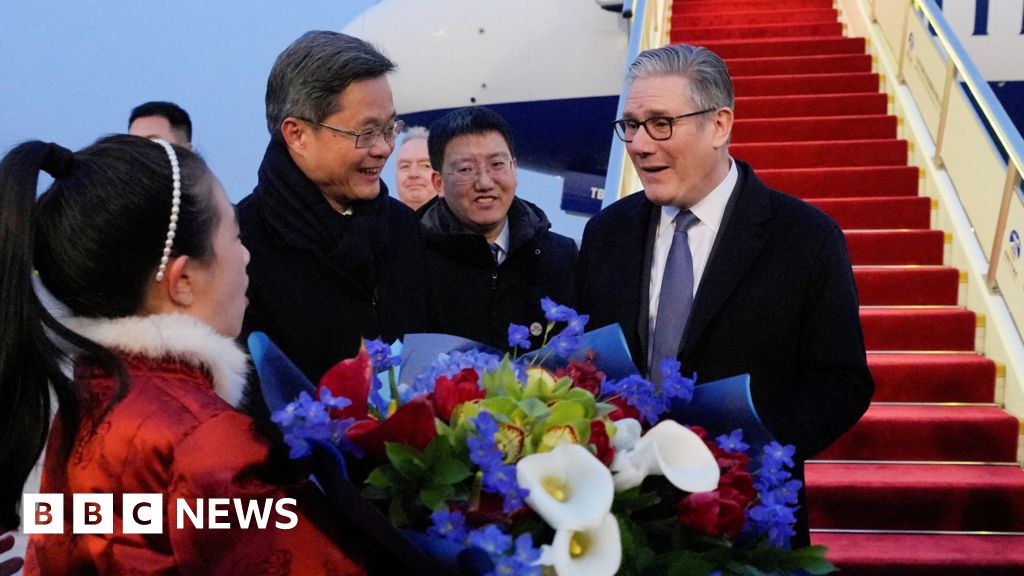
China trip will bring benefits to UK, Starmer insists, as he lands in BeijingImage Credit: BBC News
Key Points
- •LONDON/BEIJING – Prime Minister Keir Starmer arrived in Beijing on Tuesday, launching a high-stakes diplomatic mission aimed at bolstering the UK's flagging economy through deeper trade and investment ties with China. The Prime Minister insists the trip is a pragmatic necessity that "will bring tangible benefits back to Britain," but he lands amid a fierce political firestorm at home, with critics accusing him of sacrificing national security and human rights for economic gain.
- •Trade & Investment: The primary goal is to unlock new opportunities for British businesses. The focus is on securing market access for the UK's world-leading financial and professional services, promoting British exports, and attracting Chinese investment into UK infrastructure and technology projects.
- •Global Cooperation: The government maintains that dialogue with Beijing is essential for tackling transnational challenges. Discussions are expected to cover climate change, global health security, and economic stability, areas where Chinese cooperation is deemed indispensable.
- •Diplomatic Channels: A key aim is to re-establish and strengthen lines of communication at the highest level. The government argues that direct, frank conversations are the only way to manage disagreements and reduce the risk of miscalculation on sensitive geopolitical issues.
- •Human Rights Abuses: The continued imprisonment of British publisher Jimmy Lai in Hong Kong and the systematic persecution of the Uyghur minority in Xinjiang are central to the critique. Activists demand these issues be publicly raised, not just discussed behind closed doors.
China trip will bring benefits to UK, Starmer insists, as he lands in Beijing
LONDON/BEIJING – Prime Minister Keir Starmer arrived in Beijing on Tuesday, launching a high-stakes diplomatic mission aimed at bolstering the UK's flagging economy through deeper trade and investment ties with China. The Prime Minister insists the trip is a pragmatic necessity that "will bring tangible benefits back to Britain," but he lands amid a fierce political firestorm at home, with critics accusing him of sacrificing national security and human rights for economic gain.
The visit, the first by a British Prime Minister in over five years, marks a pivotal moment in the UK's evolving China strategy. It seeks to navigate the treacherous path between economic engagement and confronting what the government's own Integrated Review refresh termed an "epoch-defining and systemic challenge."
Starmer's Economic Gambit
The government's core message is one of "robust pragmatism." Officials argue that disengagement from the world's second-largest economy is not a viable option for a post-Brexit Britain seeking new avenues for growth. The Prime Minister's delegation includes senior executives from the financial services, automotive, and green energy sectors.
The stated objectives of the three-day visit are clear and heavily weighted towards economic outcomes.
- Trade & Investment: The primary goal is to unlock new opportunities for British businesses. The focus is on securing market access for the UK's world-leading financial and professional services, promoting British exports, and attracting Chinese investment into UK infrastructure and technology projects.
- Global Cooperation: The government maintains that dialogue with Beijing is essential for tackling transnational challenges. Discussions are expected to cover climate change, global health security, and economic stability, areas where Chinese cooperation is deemed indispensable.
- Diplomatic Channels: A key aim is to re-establish and strengthen lines of communication at the highest level. The government argues that direct, frank conversations are the only way to manage disagreements and reduce the risk of miscalculation on sensitive geopolitical issues.
Speaking to reporters before his departure, Mr. Starmer stated, "We have to be clear-eyed about our relationship with China. We will be robust in defending our interests and our values, but we will also be practical. To not engage would be to cede ground and opportunity to our global competitors."
A Chorus of Criticism at Home
The Prime Minister's economic rationale has failed to quell a growing chorus of dissent from opposition parties, human rights organisations, and security hawks within his own party. Critics argue the visit projects weakness and legitimises a regime engaged in deeply concerning activities.
The sharpest rebuke came from Liberal Democrat deputy leader Daisy Cooper, who encapsulated the opposition's fears. "Whilst the Chinese regime still holds British citizen Jimmy Lai captive in prison, and whilst the Chinese regime continues to hunt down pro-democracy protesters on the streets of Britain with bounties on their heads, the British prime minister has gone cap in hand to China to ask for a trade deal on the promise of a super-embassy from which the Chinese regime will continue to spy on us," she said.
This criticism highlights several specific and deeply divisive issues that shadow the Prime Minister's trip.
- Human Rights Abuses: The continued imprisonment of British publisher Jimmy Lai in Hong Kong and the systematic persecution of the Uyghur minority in Xinjiang are central to the critique. Activists demand these issues be publicly raised, not just discussed behind closed doors.
- National Security Threats: Concerns are mounting over Chinese state-sponsored activities on UK soil. This includes the alleged operation of clandestine "police stations," the sanctioning of UK parliamentarians, and the placing of bounties on pro-democracy activists residing in Britain.
- The 'Super-Embassy': The planned construction of a new, vast Chinese embassy on the site of the former Royal Mint near the Tower of London has become a flashpoint. Security officials have reportedly warned it could become a hub for espionage, given its size and strategic location.
The Economic Imperative
The backdrop to this diplomatic tightrope walk is the UK's challenging economic landscape. Facing sluggish GDP growth, persistent inflation, and the continued economic friction of Brexit, the government is under immense pressure to deliver a positive economic narrative.
China remains a critical, if complex, economic partner. It is the UK's fourth-largest trading partner, with total trade in goods and services amounting to over £100 billion annually. For key sectors, this relationship is vital.
Sectors to Watch
The success of the trip, from a business perspective, will be measured by progress in several key areas.
- Financial Services: The City of London is keen to expand its role as a leading offshore hub for the Renminbi. UK-based asset managers also see enormous potential in China's vast and growing pool of domestic savings.
- Automotive Industry: The UK car industry is deeply integrated with Chinese supply chains, particularly for electric vehicle (EV) batteries. Simultaneously, the rapid influx of Chinese EV brands like BYD and MG into the UK market presents both competition and potential for investment in UK manufacturing.
- Green Technology: While China dominates the production of solar panels and wind turbines, the UK has expertise in green finance, R&D, and offshore wind development. The government hopes to position the UK as a partner for financing and designing the next wave of green infrastructure.
Navigating a 'Defining Challenge'
Ultimately, this visit is a high-wire act. The Prime Minister must return with demonstrable economic "wins" to justify the political capital he has expended. This could take the form of market access agreements, memoranda of understanding for future investment, or simply a warming of commercial relations.
However, he will also be judged on his ability to address the security and human rights concerns without derailing the economic agenda. The prevailing strategy in Western capitals has shifted from "engagement" to "de-risking"—a policy of reducing critical dependencies on China without pursuing a full economic decoupling.
The outcomes of Mr. Starmer's meetings with President Xi Jinping and Premier Li Qiang will be scrutinised intensely. The language of the final communiqués, the tone of public statements, and any concrete deals announced will set the course for the UK-China relationship for years to come, defining Britain's place in a world increasingly shaped by the rivalry between Washington and Beijing.
Source: BBC News
Related Articles
ARRY Stock Sinks Despite Market Gains: What to Know
Array Technologies (ARRY) stock declined 2.5% in the latest session, contrasting with market gains. Find out why the solar stock fell and what it means for inve
India and the EU clinch the 'mother of all deals' in a histo
Jay Vine Wins Tour Down Under 2026 After Kangaroo Crash
Australian cyclist Jay Vine secures the overall victory at the 2026 Tour Down Under despite a dramatic final-stage crash involving a kangaroo.
Trump's New Defense Strategy: Allies Must Fund Own Security
The Trump administration's new National Defense Strategy realigns US policy, demanding allies assume primary responsibility for their own security and defense c