Starmer's Past Legal Work on Iraq Vets Sparks Backlash
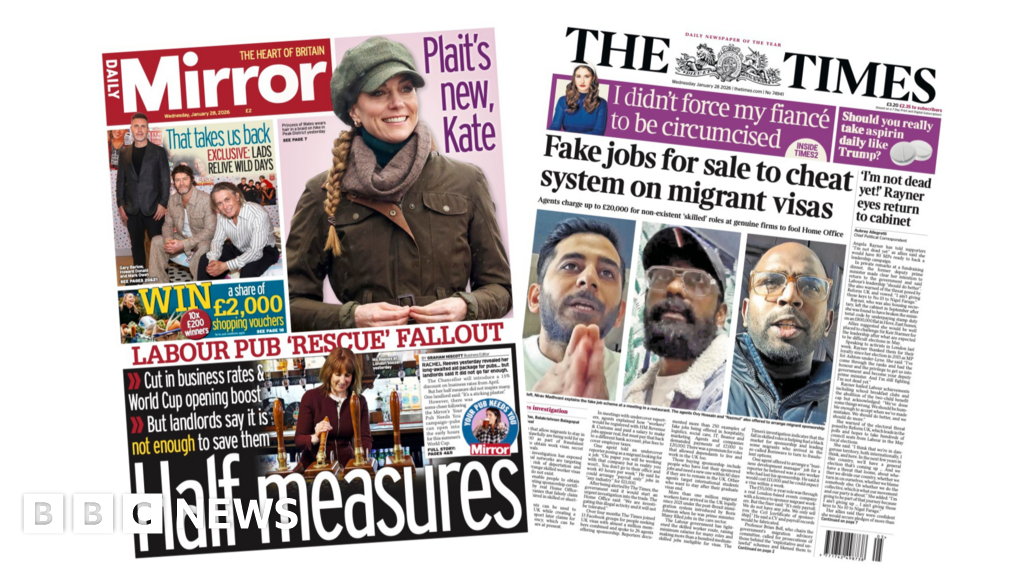
Newspaper headlines: 'Half measures' and 'Fake jobs for sale'Image Credit: BBC News
Key Points
- •LONDON – Downing Street has mounted a staunch defence of Prime Minister Sir Keir Starmer's past legal career, following a front-page report in The Telegraph accusing him of leading a "witch-hunt" against British Iraq war veterans. The controversy centres on a landmark 2007 human rights case that significantly altered the legal landscape for UK troops operating abroad, with critics alleging it triggered years of costly and damaging investigations into service personnel.
- •The Al-Skeini Case: The 2007 case is widely understood to be Al-Skeini and others v. Secretary of State for Defence. This pivotal House of Lords ruling (later upheld by the European Court of Human Rights) established that the European Convention on Human Rights (ECHR) could apply to the actions of British forces in Iraq, specifically concerning Iraqi civilians who died in UK custody. It effectively extended the jurisdiction of human rights law beyond UK borders to areas under British military control.
- •Sir Keir's Legal Position: As a leading human rights QC at the time, Sir Keir Starmer's involvement was significant. While Downing Street now frames his role as assisting the court, he was acting for the claimants—the families of the Iraqi civilians. His task was to argue the legal points that ultimately led to the court's decision to extend ECHR jurisdiction. This distinction is at the core of the political dispute: was he an impartial legal expert or a partisan barrister advancing a specific cause?
- •The Financial Fallout: The "enormous cost" cited by The Telegraph primarily refers to the Iraq Historic Allegations Team (IHAT). Established in 2010 to investigate allegations of abuse by British troops, IHAT spent approximately £57 million over its seven-year existence. It examined thousands of claims, but the vast majority were dismissed without prosecution, and the body was eventually shut down in 2017 amid widespread criticism of its methods and the conduct of law firms funnelling claims to it.
- •Political Motivations: The timing of this report is not coincidental. Reviving this issue allows political opponents to construct a narrative that questions the Prime Minister's patriotism and judgment. By linking him to the controversial IHAT investigations, they aim to paint him as being on the "wrong side" of a battle between human rights lawyers and the armed forces, a sensitive fault line in British public life.
Here is the complete news article in markdown format.
PM Starmer's Past as Human Rights Barrister Under Fire Over Impact on Iraq Veterans
LONDON – Downing Street has mounted a staunch defence of Prime Minister Sir Keir Starmer's past legal career, following a front-page report in The Telegraph accusing him of leading a "witch-hunt" against British Iraq war veterans. The controversy centres on a landmark 2007 human rights case that significantly altered the legal landscape for UK troops operating abroad, with critics alleging it triggered years of costly and damaging investigations into service personnel.
The report has reignited a sensitive debate over the balance between military accountability and the protection of soldiers from vexatious legal claims. While No. 10 insists the Prime Minister's role was purely procedural and in service to the court, the allegations strike at the heart of his public image and relationship with the armed forces, promising to be a recurring theme for his political opponents.
The Core Allegation
The Telegraph's report focuses on Sir Keir's work as the lead barrister on a 2007 human rights claim. The newspaper asserts that this legal action "reshaped the law governing troops in war zones."
According to the paper, the direct consequence of this case was the initiation of numerous criminal investigations into soldiers. It frames these inquiries as targeting "wrongly accused" individuals, culminating in a protracted and painful process for the veterans involved and incurring an "enormous cost" for the British taxpayer. The "witch-hunt" characterisation suggests a politically or ideologically motivated pursuit rather than a necessary legal process.
Downing Street's Rebuttal
In response to the allegations, the Prime Minister's office provided a firm and detailed rebuttal, seeking to reframe Sir Keir's involvement from that of an activist advocate to a neutral officer of the court.
A spokesperson for Downing Street told The Telegraph that in the case, Sir Keir had not advocated for "either side." Instead, his designated role was to "assist the court on points of law." This suggests his function was akin to an amicus curiae (friend of the court), providing expert legal interpretation to help the judges navigate complex legal territory, rather than representing the claimants against the Ministry of Defence.
The spokesperson added a personal assurance, stating that the Prime Minister would "never forget" the profound sacrifices made by British servicemen and women, aiming to counter any narrative that questions his support for the military.
Context: The Landmark Case and Its Fallout
To understand the current controversy, it is essential to examine the legal and historical context of the case in question and its subsequent impact.
-
The Al-Skeini Case: The 2007 case is widely understood to be Al-Skeini and others v. Secretary of State for Defence. This pivotal House of Lords ruling (later upheld by the European Court of Human Rights) established that the European Convention on Human Rights (ECHR) could apply to the actions of British forces in Iraq, specifically concerning Iraqi civilians who died in UK custody. It effectively extended the jurisdiction of human rights law beyond UK borders to areas under British military control.
-
Sir Keir's Legal Position: As a leading human rights QC at the time, Sir Keir Starmer's involvement was significant. While Downing Street now frames his role as assisting the court, he was acting for the claimants—the families of the Iraqi civilians. His task was to argue the legal points that ultimately led to the court's decision to extend ECHR jurisdiction. This distinction is at the core of the political dispute: was he an impartial legal expert or a partisan barrister advancing a specific cause?
-
The Financial Fallout: The "enormous cost" cited by The Telegraph primarily refers to the Iraq Historic Allegations Team (IHAT). Established in 2010 to investigate allegations of abuse by British troops, IHAT spent approximately £57 million over its seven-year existence. It examined thousands of claims, but the vast majority were dismissed without prosecution, and the body was eventually shut down in 2017 amid widespread criticism of its methods and the conduct of law firms funnelling claims to it.
-
Political Motivations: The timing of this report is not coincidental. Reviving this issue allows political opponents to construct a narrative that questions the Prime Minister's patriotism and judgment. By linking him to the controversial IHAT investigations, they aim to paint him as being on the "wrong side" of a battle between human rights lawyers and the armed forces, a sensitive fault line in British public life.
Implications and Next Steps
The resurfacing of this decade-old legal case carries significant implications for the current political climate and the ongoing discourse surrounding military justice.
First, it signals a clear strategy by political adversaries and critical media outlets to scrutinize and weaponize Sir Keir Starmer's extensive legal past. His career as Director of Public Prosecutions and as a human rights barrister provides a deep well of complex cases that can be simplified for political attacks, regardless of the legal nuances.
Second, the debate forces a continued reckoning within the government and the Ministry of Defence over how to protect service personnel from baseless legal challenges while upholding accountability. The legacy of the Al-Skeini ruling and the subsequent IHAT saga has already led to legislative changes, including the Overseas Operations Act 2021, which introduced a presumption against prosecution for alleged offences committed more than five years ago.
Looking ahead, Downing Street will likely continue to walk a fine line, defending the Prime Minister's professional record by emphasizing the technical, apolitical nature of a barrister's duty to the court. However, with the issue now firmly back in the public domain, it is almost certain to be used as a recurring political cudgel, forcing the administration to repeatedly clarify its stance on military affairs and human rights law. The story serves as a stark reminder that in the highest echelons of power, the past is never truly past.
Source: BBC News
Related Articles
ARRY Stock Sinks Despite Market Gains: What to Know
Array Technologies (ARRY) stock declined 2.5% in the latest session, contrasting with market gains. Find out why the solar stock fell and what it means for inve
India and the EU clinch the 'mother of all deals' in a histo
Jay Vine Wins Tour Down Under 2026 After Kangaroo Crash
Australian cyclist Jay Vine secures the overall victory at the 2026 Tour Down Under despite a dramatic final-stage crash involving a kangaroo.
Trump's New Defense Strategy: Allies Must Fund Own Security
The Trump administration's new National Defense Strategy realigns US policy, demanding allies assume primary responsibility for their own security and defense c