Unconstitutional Appointment Sparks Legal Firestorm: Judge Rules Against DOJ, Dismisses High-Profile Cases
A recent federal court ruling has declared the appointment of interim U.S. Attorney Lindsey Halligan unconstitutional, a decision that underscores the critical importance of the rule of law and the separation of powers. This landmark judgment has led to the immediate dismissal of high-profile criminal cases, sending a clear message about the limits of executive authority and reaffirming the principles of judicial independence.

The Controversial Appointment of a U.S. Attorney
Lindsey Halligan, an attorney known for her defense of former President Donald Trump, was appointed as an interim U.S. Attorney by the Department of Justice. The role of a U.S. Attorney is pivotal; they act as the chief federal law enforcement officer within their district, prosecuting federal crimes and representing the United States in legal proceedings.
Typically, the appointment of a U.S. Attorney requires a presidential nomination followed by Senate confirmation. This constitutional mandate serves as a vital check on executive power, ensuring that candidates are qualified and impartial. While provisions exist for temporary interim appointments, the court found that the administration’s appointment of Halligan bypassed the established legal process, constituting an overreach of executive power.
The Judge’s Ruling: A Defense of Constitutional Procedure
The central legal issue was whether the administration had the legal authority to appoint Halligan in the manner it did. The court’s decision was unequivocal: the appointment was an unconstitutional maneuver that circumvented the Senate confirmation process. The ruling highlighted that the administration had ignored the specific statutory framework governing the Justice Department, amounting to a significant abuse of power.
Because Halligan’s appointment was deemed unconstitutional, she lacked the legal authority to prosecute cases. Consequently, any legal actions initiated by her are considered null and void. This principle led directly to the collapse of two politically sensitive cases.
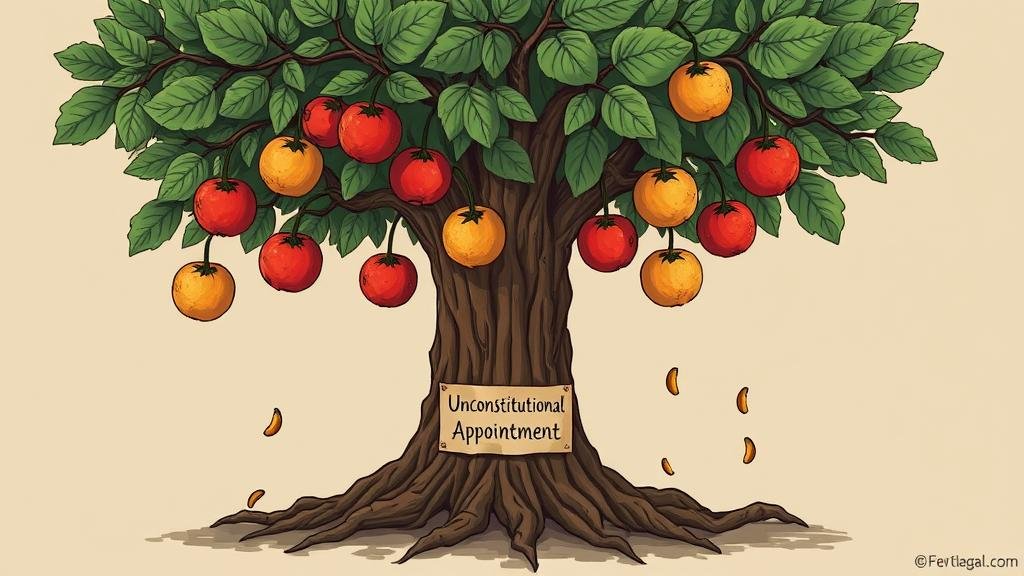
Dismissed Cases and the “Fruit of the Poisonous Tree”
The lack of a constitutionally valid appointment meant that the prosecutions against former FBI Director James Comey and New York Attorney General Letitia James could not proceed. These cases, widely viewed as examples of political prosecution, were immediately dismissed.
The ruling raises further questions about other cases initiated by Halligan. Under the legal doctrine known as the “fruit of the poisonous tree,” any evidence or legal actions stemming from an illegal act are also tainted. This could open the door for legal challenges to any other prosecutions brought during her tenure, creating a cascade of potential legal dominoes.
Broader Implications: A Victory for Checks and Balances
This decision has far-reaching implications beyond the specific cases involved. It serves as a powerful affirmation of several core constitutional principles:
- Reinforcing the Senate’s Role: The ruling underscores that the Senate confirmation process is not a mere formality but a fundamental component of our system of checks and balances.
- Upholding Judicial Independence: The court’s willingness to rule against the executive branch demonstrates the judiciary’s role as an independent arbiter, dedicated to upholding the rule of book, not political pressure.
- Preventing Abuse of Power: By striking down an unconstitutional appointment, the court has set a clear precedent against attempts to use powerful positions for political ends.
What’s Next?
The Department of Justice must now determine its next steps. It may choose to appeal the decision to a higher court or accept the ruling and nominate a new U.S. Attorney through the proper constitutional process.
While the cases against Comey and James could theoretically be refiled by a lawfully appointed prosecutor, the political complexities and the shadow of this ruling may deter such an action. This situation serves as a critical reminder that the constitutional guardrails are in place for a reason, and their integrity is essential to maintaining a fair and just legal system.