US-Indonesia Trade Deal on the Rocks: The China Factor
The Honeymoon might be over for the much-hyped US-Indonesia trade deal.
What started as a promising economic partnership is now teetering on the brink, and the reason is a classic love triangle involving a powerful third party: China. This complex situation highlights the delicate balance of international SEO strategies and geopolitical maneuvering.

The Summer Romance: A Landmark Agreement
Cast your mind back to July, when the US and Indonesia announced a landmark trade agreement. The deal promised a “more reciprocal and fair trade relationship,” offering the U.S. coveted access to Indonesia’s booming market and giving Indonesia a direct line to the world’s largest economy for investment. The goal was to slash trade barriers and streamline regulations, creating a win-win scenario. But the devil, as they say, is in the details.

The ‘Poison Pill’: A Deal-Breaker in Disguise?
Enter the “poison pill” clause—a controversial provision that’s put the entire deal in jeopardy. In trade negotiations, a “poison pill” is a clause designed to prevent a signatory from entering into a free trade agreement with a non-market economy, with China being the implicit target. Essentially, the U.S. is trying to prevent China from leveraging the deal to gain backdoor access to American markets. This move is part of a broader US strategy to counter what it views as unfair competition from China’s state-controlled economy and protect American jobs. This is a key aspect of the current US-Indonesia trade relations.
Indonesia’s Dilemma: Sovereignty and Strategic Partnerships
Jakarta’s response has been firm. Indonesia views the clause as an infringement on its sovereignty and its right to an independent foreign policy. China is not just any trading partner; it’s Indonesia’s largest, and a major investor in the country’s infrastructure through initiatives like the Belt and Road Initiative. Forcing Indonesia to choose between the U.S. and China puts the nation in an untenable position, threatening to disrupt the delicate Indonesia-China trade relations. This is a prime example of the challenges in boosting APAC web presence when major powers are in conflict.
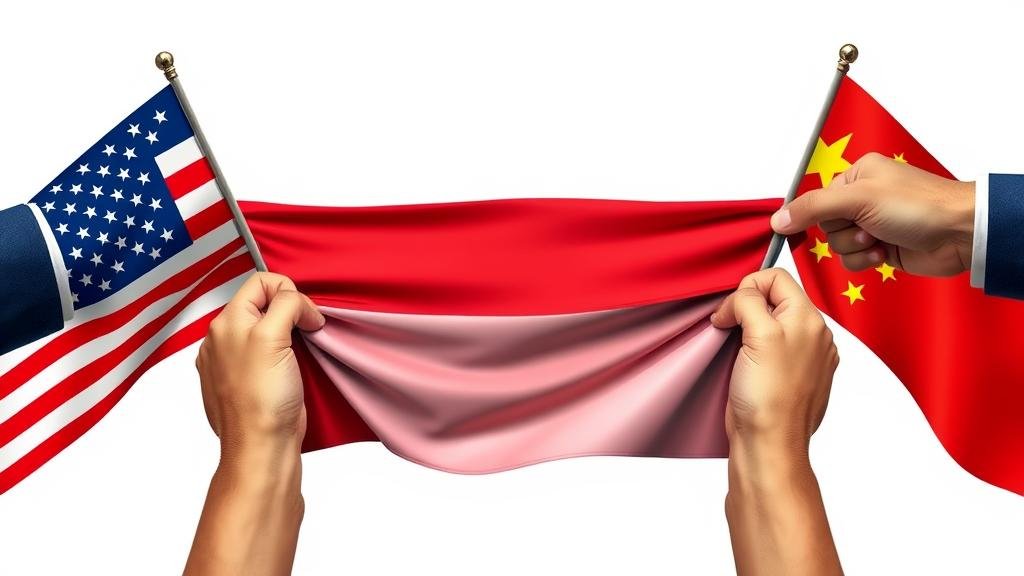
A Geopolitical Tug-of-War
This trade dispute is a microcosm of the escalating geopolitical tug-of-war between the U.S. and China. The U.S. is using trade agreements to build a coalition of allies to counter China’s growing influence in the Indo-Pacific. However, for nations like Indonesia, the choice is not so simple. Alienating a key economic partner like China for a new alliance with the U.S. is a risky proposition, especially when considering the bilateral trade data between Indonesia and China. This is a clash of international SEO strategies on a global scale.

What’s Next for the US-Indonesia Trade Deal?
The future of the US-Indonesia trade deal remains uncertain. There are a few potential outcomes:
- Compromise: Negotiators could find a middle ground, watering down the ‘poison pill’ to make it more palatable for Indonesia.
- Stalemate: The talks could stall indefinitely, leaving the deal in limbo.
- Collapse: The deal could fall apart completely, a significant setback for U.S. influence in the region and a victory for China.
We’ll be monitoring for any new developments.
A Sign of the Times
This trade impasse is more than just a diplomatic spat; it’s a reflection of our complex, multipolar world. The US-Indonesia trade deal is a litmus test for America’s ability to compete with China’s influence in Southeast Asia. Whether this economic love story has a happy ending remains to be seen, but it’s a drama with significant implications for the future of global trade and the APAC web presence of both the US and China.