US-Indonesia Trade Deal on the Rocks: A Geopolitical Soap Opera
Remember that ambitious plan you and your cousin had to build a Beanie Baby empire in ’98? It felt invincible for a hot minute, right? International trade deals can be just as fickle, but with more at stake than plush toys. The celebratory high-fives between the US and Indonesia in July have cooled, and now, whispers from Washington suggest the landmark US-Indonesia trade deal is on the verge of collapse.

The Honeymoon Phase: A Landmark Deal or a Ghosting in the Making?
This past July, the US and Indonesia were all smiles, signing a deal poised to boost economic ties. For Indonesia, it was a golden opportunity to attract significant foreign investment and gain privileged access to the world’s largest market. For the US, it was a strategic move to strengthen its presence in Southeast Asia.
The optimism was palpable. A win-win, a perfect match. But now, just months later, the partnership is showing signs of strain, and we’re all wondering if this deal is about to become another ghosting victim.
The “Poison Pill” and the Trust Issues
The crux of the issue? A “poison pill” clause. This isn’t a Cold War spy tactic, but it’s just as dramatic. In essence, the US wants to include a provision that would nullify the agreement if Indonesia enters into a free trade deal with a “non-market economy,” a not-so-subtle reference to China.
Washington views this as a necessary security measure. Jakarta, however, sees it as a major breach of trust, akin to a new partner demanding your phone password.

Indonesia’s High-Stakes Balancing Act
Indonesia’s reluctance is understandable. The nation has long prided itself on its neutrality in the ongoing US-China rivalry. Accepting the “poison pill” would be like picking a team after years of being a neutral spectator.
Moreover, China is Indonesia’s largest trading partner. Signing a deal that could jeopardize that relationship is a high-risk move. Indonesia is trying to maintain a delicate balance, and the US’s ultimatum is making that incredibly difficult. As one of the most promising emerging nations, Indonesia is asserting its right to chart its own course.
Deforestation, Double Standards, and a Dash of Drama
Adding another layer of complexity is the EU’s new anti-deforestation regulation (EUDR). This rule directly impacts Indonesia, a major palm oil producer. The rumor that the EU might grant the US an exemption has fueled a sense of injustice in Jakarta, making them even more wary of US demands.
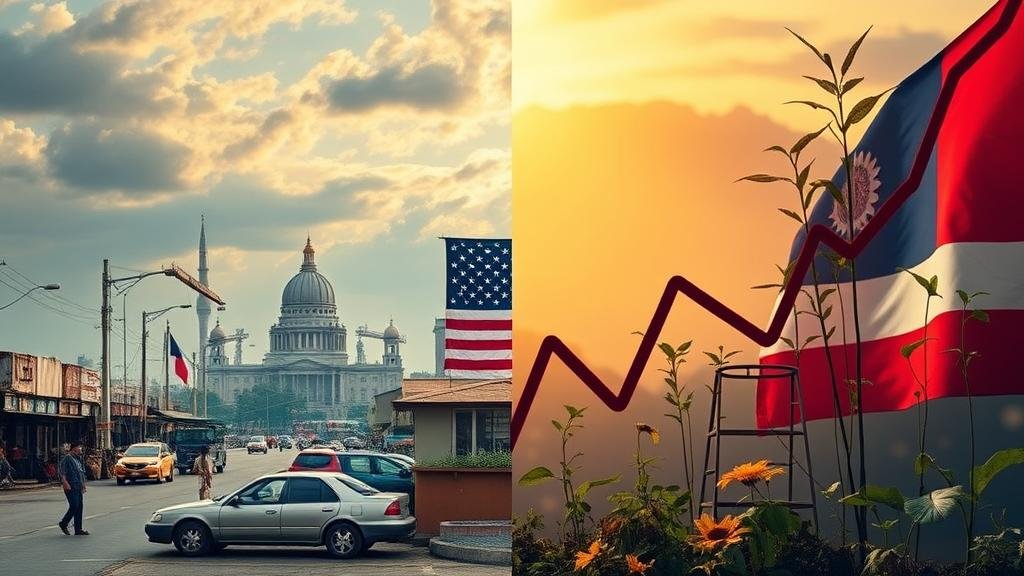
What’s at Stake? High Risks for Both Sides
If the US-Indonesia trade deal collapses, the consequences will be significant. For the United States, it would be a major strategic setback and a public relations victory for China. The failure to secure this partnership would undermine US influence in the region.
For Indonesia, the stakes are equally high. They would miss out on a massive influx of foreign investment, job creation, and access to a market of 330 million consumers. The resulting uncertainty could deter investors and destabilize the Indonesian rupiah. The deal’s collapse would also have a chilling effect on US ag exports to the region.
The Bottom Line: Geopolitical Risk is the New Norm
The era of the US dictating terms to the rest of the world is over. Emerging nations like Indonesia are coming to the negotiating table with their own agendas and aren’t afraid to push back. For businesses and investors, this is a clear sign: geopolitical risk is no longer an abstract concept but a critical factor in any international venture.
Can This Deal Be Saved?
The future of the US-Indonesia trade deal is uncertain. To salvage it, Washington must adopt a more flexible approach, and Jakarta must weigh the benefits of a US partnership against the potential costs. A compromise, perhaps a revised “poison pill” clause that focuses on mutual cooperation, could offer a path forward.
Will this trade marriage be saved? Or will it end in a bitter divorce? We’ll be watching, popcorn in hand, to see how this geopolitical drama unfolds.