Why Poundland Struggles in a Cost-of-Living Crisis
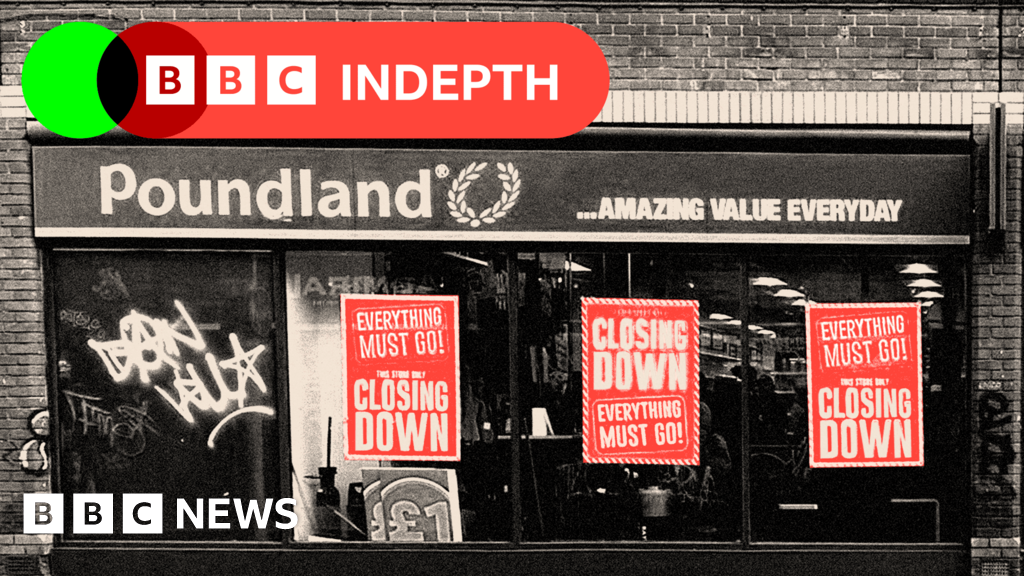
Why Poundland is struggling during a cost-of-living-crisisImage Credit: BBC Business (Finance)
Key Points
- •London, UK – The closure of Poundland’s Peckham branch this week, after 11 years on a bustling south London high street, presents a stark paradox at the heart of the UK economy. For shoppers like Becky Cullen, the loss is acute. "Everyone comes in here, it's very cheap," she noted, looking at the now-empty storefront. "It was always busy... Where are we going to shop now?" Her question encapsulates a wider, more complex issue: in an era defined by a severe cost-of-living crisis, why are the very stores designed to thrive on bargain-hunting facing an existential threat?
- •Store Closures: More than 100 of its shops have either been shut or are earmarked for closure since the summer of 2025.
- •Reduced Portfolio: By the end of this restructuring process, Poundland anticipates operating between 650 and 700 stores, a sharp decline from the roughly 800 it had at the start of the year.
- •The Savvy Shopper: Consumers have become more strategic and discerning than ever before. Retail expert Catherine Shuttleworth of Savvy notes that shoppers are effectively "outsmarting the budget shops." They no longer perform a full shop in one location but instead "know their prices inside out," cherry-picking the best deals from various retailers. The use of smartphones to instantly share price comparisons with friends and family has weaponised this behaviour, eroding store loyalty.
- •Squeezed Operating Margins: All retailers have been hit by rising operational costs, particularly following last year's Budget which increased employer expenses. For discounters, this pressure is magnified. Their business model is built on high volume and razor-thin margins, leaving little room to absorb increased overheads. Passing these costs onto a price-sensitive customer base is a perilous move that risks alienating their core demographic.
Why Poundland is struggling during a cost-of-living-crisis
London, UK – The closure of Poundland’s Peckham branch this week, after 11 years on a bustling south London high street, presents a stark paradox at the heart of the UK economy. For shoppers like Becky Cullen, the loss is acute. "Everyone comes in here, it's very cheap," she noted, looking at the now-empty storefront. "It was always busy... Where are we going to shop now?" Her question encapsulates a wider, more complex issue: in an era defined by a severe cost-of-living crisis, why are the very stores designed to thrive on bargain-hunting facing an existential threat?
The scene in Peckham, a community with high levels of deprivation where a discount store should be a lifeline, is being replicated across the country. Poundland, a household name in British retail, is not merely closing one underperforming store. It is in the midst of a radical restructuring to secure its future, a process that highlights a fundamental shift in the economics of budget retail.
A Sector Under Pressure
Poundland's difficulties are a clear signal of a sector-wide malaise. The company's recent sale in June for a nominal £1, attributed to "challenging trading conditions," was a dramatic indicator of the deep-seated problems facing its business model. This has since been followed by a significant consolidation strategy.
The company is executing a turnaround plan that involves a substantial reduction of its physical footprint.
- Store Closures: More than 100 of its shops have either been shut or are earmarked for closure since the summer of 2025.
- Reduced Portfolio: By the end of this restructuring process, Poundland anticipates operating between 650 and 700 stores, a sharp decline from the roughly 800 it had at the start of the year.
This is not an isolated case. The distress is evident across the discount landscape. The Original Factory Shop is also shrinking, having closed at least 22 locations. Smaller chains like Maxideal have ceased trading altogether. Even B&M Bargains, one of the sector's titans, has been forced to launch its own turnaround plan in response to weakening sales. This trend runs counter to the logical assumption that a financially squeezed populace would flock to these retailers in record numbers.
The Anatomy of a Discount Dilemma
The struggles of Poundland and its peers stem not from a lack of demand for bargains, but from a convergence of economic pressures and a fundamental evolution in consumer behaviour. The old rules of discount retail no longer apply.
A Perfect Storm of Challenges
-
The Savvy Shopper: Consumers have become more strategic and discerning than ever before. Retail expert Catherine Shuttleworth of Savvy notes that shoppers are effectively "outsmarting the budget shops." They no longer perform a full shop in one location but instead "know their prices inside out," cherry-picking the best deals from various retailers. The use of smartphones to instantly share price comparisons with friends and family has weaponised this behaviour, eroding store loyalty.
-
Squeezed Operating Margins: All retailers have been hit by rising operational costs, particularly following last year's Budget which increased employer expenses. For discounters, this pressure is magnified. Their business model is built on high volume and razor-thin margins, leaving little room to absorb increased overheads. Passing these costs onto a price-sensitive customer base is a perilous move that risks alienating their core demographic.
-
The Devalued Pound: For single-price retailers like Poundland, inflation has rendered their core value proposition almost obsolete. The purchasing power of £1 has dramatically eroded. An item sold for £1 when Poundland was founded in 1990 is equivalent to selling it for just 40p today in real terms. This makes it nearly impossible to source quality goods and maintain profitability at the iconic single-price point.
The OneBeyond Model: A Blueprint for Survival?
While some legacy discounters falter, new models are proving more resilient. The story of Chris Edwards, the entrepreneur who founded Poundworld and sold it for £150 million a decade ago, offers a compelling case study in adaptation.
His latest venture, initially named OneBelow and selling everything for £1 or less, was forced to pivot. "We realised the pound game wasn't going to work any more," Mr. Edwards states, citing the post-pandemic shipping crisis and soaring freight costs as the final straw.
The business was rebranded as OneBeyond, with a flexible pricing structure where most items are sold for £1 or more. This strategic shift away from a rigid price point has been crucial to its success. A weekend visit to its Croydon store reveals a bustling aisles and long queues, with shoppers stocking up on a wide array of goods.
The Edwards Formula
Mr. Edwards attributes his success to a combination of deep industry knowledge and operational agility.
-
Flexible Pricing: By abandoning the restrictive "everything for a pound" model, the business can react to inflation and sourcing costs while still offering compelling value on a broader range of products.
-
Expert Sourcing and Negotiation: With over 50 years in the industry, Edwards leverages a "constant flow of containers from China" to "negotiate very keen prices." This direct, high-volume sourcing provides a critical competitive edge.
-
Strategic Loss Leaders: The business consciously sacrifices profit margins on certain high-demand, big-name brand products. This tactic drives significant footfall, with customers then purchasing other, more profitable items during their visit. As Edwards puts it, "We know what the customer is going to buy before the customer knows they're going to buy it."
The Future of the High Street Discounter
The turmoil in the discount sector signals a critical turning point. The simple, single-price model that defined a generation of bargain shopping is no longer viable in the current economic climate. Poundland's painful restructuring is a necessary, if difficult, response to this new reality.
The path forward for these retailers lies in the blueprint offered by agile competitors like OneBeyond. Success will be defined by pricing flexibility, sophisticated global sourcing, and a deep, data-driven understanding of a new breed of tactical, price-savvy consumers.
For Poundland, the goal of stabilising at around 650-700 stores represents a more sustainable, if smaller, future. The challenge will be to re-engineer its operations and value proposition to compete in a world where the word "pound" in its name is more of a brand heritage than a literal price tag. The evolution of the discounter is a microcosm of the high street's broader struggle: adapt to the new economic reality or risk becoming a relic of a bygone era.
Source: BBC Business (Finance)
Related Articles
ARRY Stock Sinks Despite Market Gains: What to Know
Array Technologies (ARRY) stock declined 2.5% in the latest session, contrasting with market gains. Find out why the solar stock fell and what it means for inve
India and the EU clinch the 'mother of all deals' in a histo
Jay Vine Wins Tour Down Under 2026 After Kangaroo Crash
Australian cyclist Jay Vine secures the overall victory at the 2026 Tour Down Under despite a dramatic final-stage crash involving a kangaroo.
Trump's New Defense Strategy: Allies Must Fund Own Security
The Trump administration's new National Defense Strategy realigns US policy, demanding allies assume primary responsibility for their own security and defense c