Comac: The Chinese planemaker taking on Boeing & Airbus
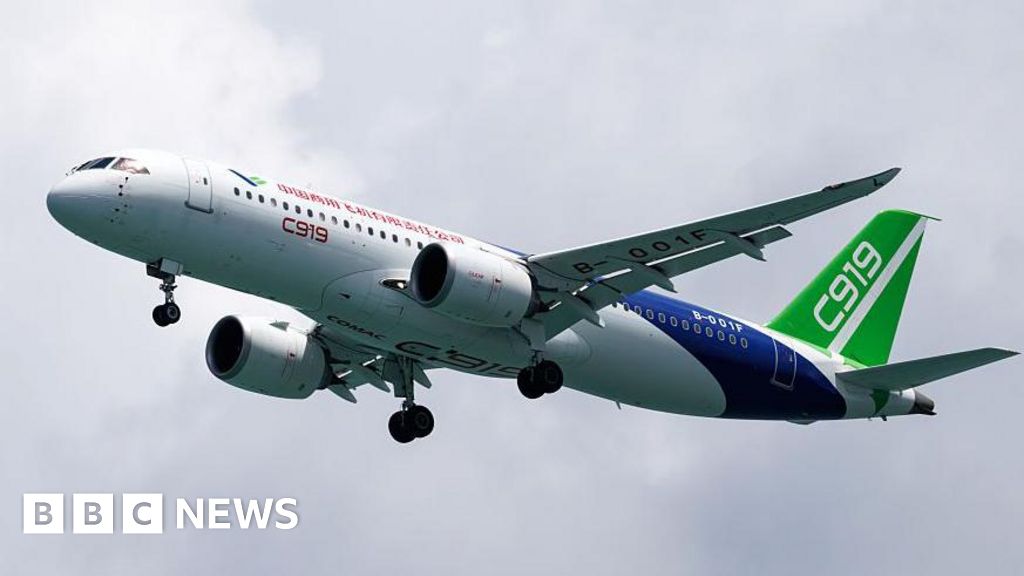
Comac: The Chinese planemaker taking on Boeing and AirbusImage Credit: BBC Business (Finance)
Key Points
- •LONDON – For decades, the commercial aviation skyline has been dominated by two giants: Boeing and Airbus. Now, a state-backed challenger from China is taxiing for takeoff, and some in the industry are watching with keen interest, signaling a potential tectonic shift in the multi-trillion-dollar global aircraft market.
- •Market Control: Boeing and Airbus collectively account for over 90% of the global large commercial jet fleet.
- •Production Bottlenecks: Both manufacturers have faced significant supply chain and production challenges, delaying aircraft deliveries and frustrating airline customers eager to expand and modernise their fleets.
- •Why it Matters: The entrance of a credible third competitor could introduce price pressure, spur innovation, and provide airlines with crucial supply chain diversification.
- •Direct Competitors: Airbus A320neo family, Boeing 737 MAX family.
Comac: The Chinese planemaker taking on Boeing and Airbus
LONDON – For decades, the commercial aviation skyline has been dominated by two giants: Boeing and Airbus. Now, a state-backed challenger from China is taxiing for takeoff, and some in the industry are watching with keen interest, signaling a potential tectonic shift in the multi-trillion-dollar global aircraft market.
The clearest sign of this emerging reality comes not from Beijing, but from a key customer in one of the world's fastest-growing aviation regions.
"In the future we welcome all newcomers. We are keen to see more competition," Mike Szucs, chief executive of the Philippines' largest carrier, Cebu Pacific, told the BBC. Szucs's timeline is patient but clear: "Comac has got its certification process to go through and at some point in the 2030s, we see that it will be an offering that would be attractive to ourselves and other carriers."
His comments underscore a quiet but growing sentiment among airlines: the duopoly's grip may not be permanent, and a third major player could reshape the industry's economics.
The State of the Duopoly
The market for large commercial aircraft is one of the world's most consolidated. The American behemoth Boeing and the European consortium Airbus command a near-total market share, creating a powerful duopoly with enormous barriers to entry.
This dominance gives them significant pricing power and creates vast order backlogs, sometimes stretching for years. For airlines, this means limited negotiating leverage and long waits for new, fuel-efficient aircraft.
- Market Control: Boeing and Airbus collectively account for over 90% of the global large commercial jet fleet.
- Production Bottlenecks: Both manufacturers have faced significant supply chain and production challenges, delaying aircraft deliveries and frustrating airline customers eager to expand and modernise their fleets.
- Why it Matters: The entrance of a credible third competitor could introduce price pressure, spur innovation, and provide airlines with crucial supply chain diversification.
Enter Comac and the C919
At the heart of China's aerospace ambition is the Commercial Aircraft Corporation of China (Comac), a state-owned enterprise founded in 2008 with an explicit mandate: to break the Western duopoly.
Its flagship product is the C919, a narrow-body jet designed to go head-to-head with the workhorses of global aviation: the Boeing 737 MAX and the Airbus A320neo.
By the Numbers: The C919
- Direct Competitors: Airbus A320neo family, Boeing 737 MAX family.
- Passenger Capacity: 158 to 192 seats, depending on configuration.
- Development: A long and costly journey, with its maiden flight in 2017 and official certification from Chinese regulators in 2022.
- Commercial Service: The C919 entered commercial service with launch customer China Eastern Airlines in May 2023, primarily on domestic routes.
While the C919 is a product of Chinese design and final assembly, it remains heavily reliant on a global supply chain for its most critical components.
- Key Western Components: The aircraft's LEAP-1C engines are made by CFM International (a joint venture between America's GE Aviation and France's Safran Aircraft Engines), and its avionics, electrical, and landing gear systems are sourced from established Western firms like Collins Aerospace and Honeywell.
The Uphill Battle for Global Acceptance
Despite its progress, Comac faces a formidable climb to become a true global competitor. The path from a state-supported domestic champion to a trusted international supplier is fraught with technical, political, and commercial hurdles.
The most significant barrier is international certification.
- The Gold Standard: To sell to most major airlines, Comac needs a Type Certificate from the U.S. Federal Aviation Administration (FAA) and the European Union Aviation Safety Agency (EASA). This is a multi-year, intensely rigorous process that scrutinises every aspect of the aircraft's design, manufacturing, and safety.
- Current Status: While certified by the Civil Aviation Administration of China (CAAC), the C919 has yet to receive FAA or EASA approval. This effectively limits its market, for now, to China and nations that recognise Chinese certification.
Beyond regulatory approval, Comac must overcome several other major challenges.
- Production Scale-Up: Boeing and Airbus deliver hundreds of narrow-body jets each year. Comac's current production capacity is a small fraction of that. Ramping up manufacturing to a competitive level is a monumental industrial task.
- Global Support Network: Airlines operate globally and require 24/7 access to spare parts, maintenance, and technical support. Building a reliable and comprehensive MRO (Maintenance, Repair, and Overhaul) network on a global scale can take decades and billions of dollars.
- Proven Performance: Airlines are conservative buyers. They need aircraft with a proven track record of reliability, fuel efficiency, and a low total cost of ownership. The C919 is still unproven in the gruelling environment of high-cycle commercial operations.
The Way Forward: A Marathon, Not a Sprint
The timeline laid out by Cebu Pacific's CEO—the 2030s—is seen by analysts as a realistic assessment. Comac's strategy is a long game, built on three phases.
- Phase 1: Domestic Dominance. Secure the vast Chinese domestic market through state-backed orders from national carriers. This is well underway, with hundreds of commitments from Chinese airlines and lessors.
- Phase 2: Regional Influence. Expand sales to nations within China's geopolitical and economic sphere of influence, particularly across Asia, Africa, and Latin America, where Chinese certification may be more readily accepted.
- Phase 3: Global Competition. After achieving scale, building a track record, and securing EASA/FAA certification, begin competing for orders from major international carriers in Europe, the Middle East, and the Americas.
For now, the threat to Boeing and Airbus is not imminent but strategic. The very existence of Comac as a developing alternative, backed by the full weight of the Chinese state, is enough to alter long-term calculations. For airlines like Cebu Pacific, the prospect of a more competitive marketplace in the next decade is a welcome development, promising more choice and better value in the skies of the future.
Source: BBC Business (Finance)
Related Articles
Nationwide Protests Against ICE Enforcement Erupt in U.S.
Thousands are protesting ICE after the DOJ declined to investigate a fatal agent-involved shooting in Minneapolis, fueling a national movement and public anger.
Venezuela Amnesty Bill Could Free Political Prisoners
Learn about Venezuela's proposed amnesty bill to release political prisoners. The move could signal a major political shift and affect future economic sanctions
Pokémon Cancels Yasukuni Shrine Event After Backlash
The Pokémon Company has canceled an event at Tokyo's controversial Yasukuni Shrine after facing international backlash from China and South Korea.
US to Lose Measles Elimination Status: What It Means
The U.S. is poised to lose its measles elimination status due to escalating outbreaks. Learn what this downgrade means for public health and the economy.