Comac: The Chinese Planemaker Challenging Boeing & Airbus
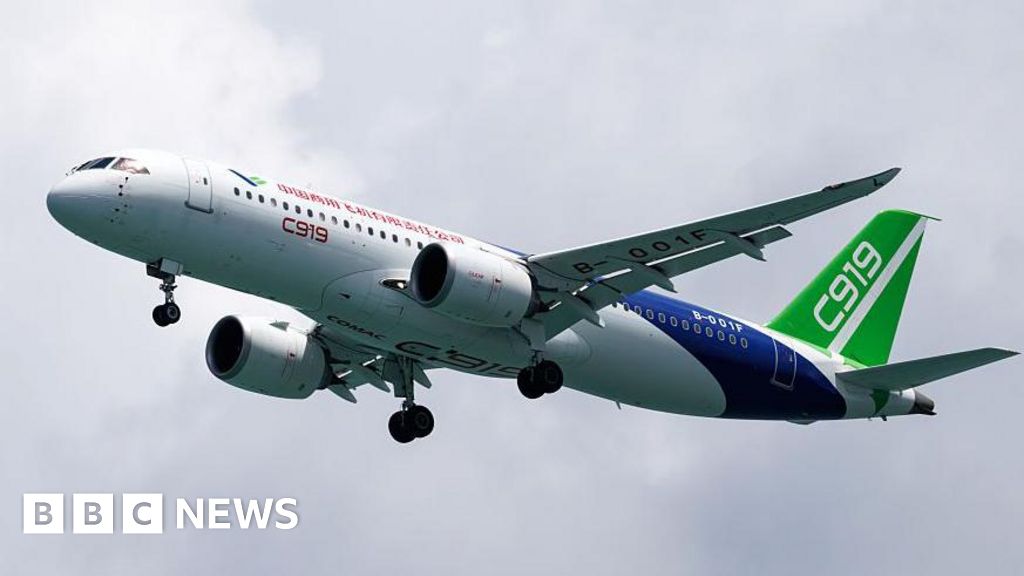
Comac: The Chinese planemaker taking on Boeing and AirbusImage Credit: BBC News
Key Points
- •LONDON – For decades, the global aviation market has been a two-horse race, a tightly controlled duopoly dominated by America’s Boeing and Europe’s Airbus. Now, a formidable, state-backed challenger is moving from the drawing board to the tarmac. China's Commercial Aircraft Corporation of China (Comac) is making its presence felt, and major airlines are beginning to take notice, signaling a potential tectonic shift in the multi-trillion-dollar aerospace industry.
- •Aircraft Class: Narrow-body, single-aisle jetliner.
- •Direct Competitors: The Airbus A320neo family and the Boeing 737 MAX series, which form the backbone of airline fleets worldwide.
- •Passenger Capacity: Typically configured to carry between 158 and 192 passengers, placing it squarely in the market's sweet spot.
- •Current Status: The C919 received its type certification from the Civil Aviation Administration of China (CAAC) in 2022. It entered commercial service with China Eastern Airlines in May 2023 and made its international debut at the Singapore Airshow in early 2024, performing flying displays for a global audience.
Comac: The Chinese planemaker taking on Boeing and Airbus
LONDON – For decades, the global aviation market has been a two-horse race, a tightly controlled duopoly dominated by America’s Boeing and Europe’s Airbus. Now, a formidable, state-backed challenger is moving from the drawing board to the tarmac. China's Commercial Aircraft Corporation of China (Comac) is making its presence felt, and major airlines are beginning to take notice, signaling a potential tectonic shift in the multi-trillion-dollar aerospace industry.
The clearest signal yet came not from a state-aligned carrier, but from a major low-cost player in a key growth market. Mike Szucs, the chief executive of Philippines-based Cebu Pacific, recently told the BBC that Comac is firmly on the airline's long-term radar. "In the future we welcome all newcomers. We are keen to see more competition," Szucs stated. "Comac has got its certification process to go through and at some point in the 2030s, we see that it will be an offering that would be attractive to ourselves and other carriers."
This endorsement, while conditional and set on a decade-long timeline, is a pivotal moment. It represents a crack in the duopoly's armor, suggesting that the industry's frustration with production delays and a lack of choice is creating a real market opening for a third player.
The Challenger from Shanghai
Comac is no startup. It is the centerpiece of Beijing's "Made in China 2025" industrial strategy, a state-owned enterprise founded in 2008 with an explicit mandate: to break the Western stranglehold on the large commercial jet market.
After years of development, its flagship aircraft, the C919, is now a reality. Designed to compete directly with the world's most popular jets, it represents a significant leap in China's aerospace capabilities.
The C919: A Closer Look
The C919 is the aircraft that Boeing and Airbus will be watching most closely. It is engineered to capture a significant share of the lucrative single-aisle market.
- Aircraft Class: Narrow-body, single-aisle jetliner.
- Direct Competitors: The Airbus A320neo family and the Boeing 737 MAX series, which form the backbone of airline fleets worldwide.
- Passenger Capacity: Typically configured to carry between 158 and 192 passengers, placing it squarely in the market's sweet spot.
- Current Status: The C919 received its type certification from the Civil Aviation Administration of China (CAAC) in 2022. It entered commercial service with China Eastern Airlines in May 2023 and made its international debut at the Singapore Airshow in early 2024, performing flying displays for a global audience.
An Uphill Battle: Hurdles and Headwinds
While Comac has the full backing of the Chinese state, its path to global relevance is fraught with significant challenges. Breaking into this high-stakes industry requires more than just building a plane.
-
International Certification: This is the single greatest obstacle. For Comac to sell the C919 to major international airlines like Cebu Pacific, it needs certification from the European Union Aviation Safety Agency (EASA) and the U.S. Federal Aviation Administration (FAA). This is a rigorous, multi-year process that scrutinizes every aspect of the aircraft's design, manufacturing, and safety. It is also subject to geopolitical tensions.
-
Supply Chain Reliance: The C919 is assembled in China, but it is not entirely "Made in China." It relies heavily on a global supply chain for critical components, including its engines. The LEAP-1C engines are made by CFM International, a joint venture between America's GE Aerospace and France's Safran Aircraft Engines—the same consortium that powers the 737 MAX and many A320neos. This creates a strategic vulnerability for Beijing and a complex interdependence with the West.
-
Production Scale: Boeing and Airbus have production rates that number in the hundreds of aircraft per year. Comac is currently in the low double-digits. Ramping up production to a level that can satisfy large orders, reduce unit costs, and compete on delivery times is a monumental industrial challenge.
-
Market Trust and Support: Airlines are inherently conservative. They buy aircraft based on proven reliability, fuel efficiency, and a robust global network for maintenance, repair, and overhaul (MRO). Comac must build this ecosystem of trust and after-sales support from the ground up, a process that takes decades.
A Window of Opportunity
Comac's emergence coincides with a period of turmoil for the duopoly. Boeing is grappling with intense scrutiny over its manufacturing quality and safety culture following a series of high-profile incidents. Airbus, while in a stronger position, is facing a colossal order backlog that stretches for years, leaving airlines with long waits for new aircraft.
This environment creates a powerful incentive for carriers to consider alternatives. The lack of competition has led to rising prices and limited negotiating power for airlines. The mere presence of a viable third option could introduce new pricing dynamics and give customers like Cebu Pacific more leverage.
The Path Forward
Comac's strategy is clear and pragmatic. The initial focus is on dominating its vast, state-controlled domestic market. Chinese airlines are expected to place substantial orders, allowing Comac to scale production and establish a track record of operational hours in a controlled environment.
The next phase will likely target nations within China's geopolitical orbit, particularly those involved in the Belt and Road Initiative, where CAAC certification may be more readily accepted.
For the rest of the world, the 2030s timeline outlined by Cebu Pacific's CEO appears realistic. The journey is long, but the destination is clear. The Boeing-Airbus duopoly is not over, but for the first time in a generation, its foundation is being seriously tested. The rise of Comac is not just an aviation story; it is a story of shifting global economic power and technological ambition that will reshape the skies for decades to come.
Source: BBC News
Related Articles
Nationwide Protests Against ICE Enforcement Erupt in U.S.
Thousands are protesting ICE after the DOJ declined to investigate a fatal agent-involved shooting in Minneapolis, fueling a national movement and public anger.
Venezuela Amnesty Bill Could Free Political Prisoners
Learn about Venezuela's proposed amnesty bill to release political prisoners. The move could signal a major political shift and affect future economic sanctions
Pokémon Cancels Yasukuni Shrine Event After Backlash
The Pokémon Company has canceled an event at Tokyo's controversial Yasukuni Shrine after facing international backlash from China and South Korea.
US to Lose Measles Elimination Status: What It Means
The U.S. is poised to lose its measles elimination status due to escalating outbreaks. Learn what this downgrade means for public health and the economy.