Drone incidents near UK military bases double year-on-year
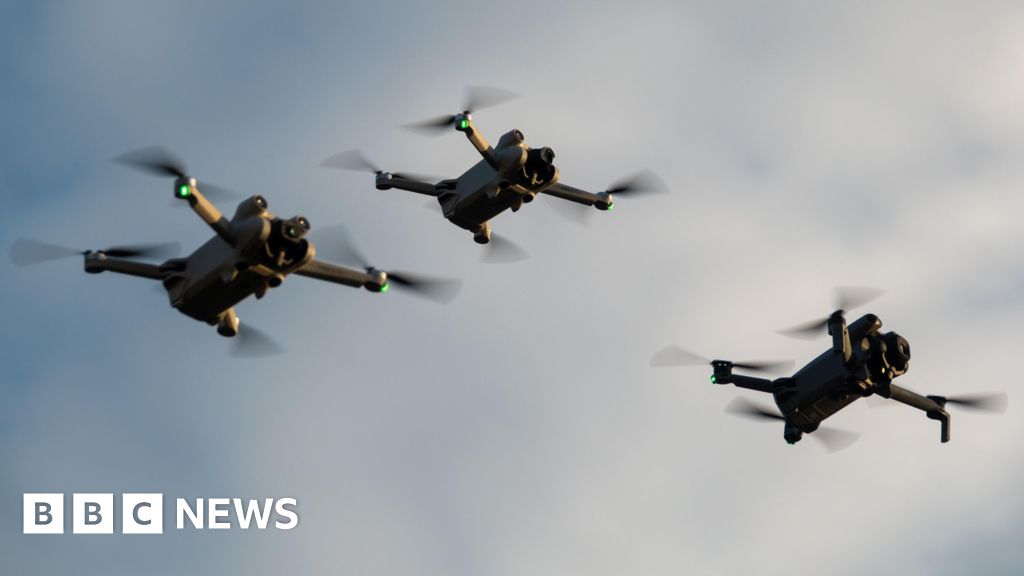
Drone incidents near UK military bases double year-on-yearImage Credit: BBC Politics
Key Points
- •LONDON – A sharp and concerning rise in drone incidents reported near sensitive UK military installations has more than doubled in the past year, exposing a critical vulnerability in national security. The surge in unauthorised aerial activity has prompted the government to fast-track new legislation granting the military direct powers to counter these threats, including for the first time, those operating underwater.
- •Incident Types: Reports include drones flying over airfields, hovering near warships in port, and mapping the perimeters of barracks and research facilities.
- •Geographic Scope: The incidents are widespread, affecting numerous MoD sites across England, Scotland, Wales, and Northern Ireland, with a particular focus on operational airbases and key naval ports.
- •Response Delay: The requirement to contact local police introduces a significant time lag, during which a drone can gather intelligence or execute a hostile act and disappear.
- •Jurisdictional Confusion: Police authority and capability vary by region, and they are not typically equipped or trained to handle potential military-level threats.
Drone incidents near UK military bases double year-on-year
LONDON – A sharp and concerning rise in drone incidents reported near sensitive UK military installations has more than doubled in the past year, exposing a critical vulnerability in national security. The surge in unauthorised aerial activity has prompted the government to fast-track new legislation granting the military direct powers to counter these threats, including for the first time, those operating underwater.
The latest figures, sourced from a BBC Politics investigation, paint a stark picture of a rapidly escalating problem. These incidents, ranging from simple airspace breaches to suspected hostile surveillance, highlight the growing challenge posed by the proliferation of cheap, commercially available unmanned aircraft systems (UAS).
Until now, a legal grey area has hampered the military's ability to respond decisively, forcing personnel to rely on civilian police forces to intervene—a process often too slow to counter a fast-moving aerial threat.
The Scale of the Problem
The year-on-year doubling of reported incidents underscores the urgency of the situation. While the Ministry of Defence (MoD) does not release precise numbers for security reasons, sources confirm the trend is consistent across air, naval, and army bases.
These incursions are not treated as trivial. The primary concern is espionage, with small, difficult-to-detect drones capable of capturing high-resolution imagery of secure facilities, troop movements, and high-value assets like fighter jets and naval vessels. The potential for drones to be adapted to carry explosives, as demonstrated in conflicts globally, represents a more direct, physical threat.
- Incident Types: Reports include drones flying over airfields, hovering near warships in port, and mapping the perimeters of barracks and research facilities.
- Geographic Scope: The incidents are widespread, affecting numerous MoD sites across England, Scotland, Wales, and Northern Ireland, with a particular focus on operational airbases and key naval ports.
A Critical Legal and Operational Gap
The core issue has been a mismatch between the threat and the legal authority to act. Military personnel, tasked with guarding billions of pounds worth of strategic assets, have been legally constrained from disabling or destroying a drone, even one operating directly over a sensitive site.
This has created a series of operational challenges:
- Response Delay: The requirement to contact local police introduces a significant time lag, during which a drone can gather intelligence or execute a hostile act and disappear.
- Jurisdictional Confusion: Police authority and capability vary by region, and they are not typically equipped or trained to handle potential military-level threats.
- Capability Mismatch: Standard police forces lack the sophisticated counter-drone (C-UAS) technology possessed by the military, such as advanced jamming, spoofing, or directed energy systems.
New Powers for a New Era of Warfare
The government's forthcoming legislation aims to close this gap decisively. The new bill will amend existing laws to grant the armed forces the explicit legal authority to take direct action against unmanned systems deemed a threat to military sites.
This represents a fundamental shift in the UK's domestic defence posture, acknowledging that the perimeter of a military base is a frontline in an era of 'grey-zone' conflict.
The key provisions of the new legislation are expected to include:
- Direct Authority: Empowering military personnel to detect, track, and neutralise unmanned aircraft operating in restricted zones without first deferring to police.
- Expanded Scope: Crucially, the powers will extend beyond aerial drones to include Uncrewed Underwater Vehicles (UUVs), or underwater drones, reflecting growing concern over the security of naval bases and submarine fleets.
- Range of Actions: Authorising a "graduated response," from electronic jamming of control signals to kinetic action—such as firing nets, lasers, or conventional weapons—as a last resort.
The Underwater Threat
The inclusion of UUVs in the legislation is a significant development, highlighting a new and sophisticated frontier in asymmetric threats. The security of naval bases, particularly HMNB Clyde at Faslane—home to the UK's nuclear deterrent—is paramount.
Small, autonomous underwater drones could potentially be used for:
- Subsea Surveillance: Mapping harbour floors, tracking submarine movements, or identifying security weaknesses in underwater defences.
- Sabotage: Placing listening devices or even explosive charges on the hulls of warships or critical infrastructure.
By extending counter-drone powers to the sub-surface domain, the government is future-proofing the UK's defences against a threat that is currently harder to detect and counter than its aerial equivalent.
Implications and Next Steps
The move to empower the military is a direct response to a changed security landscape, driven by technological proliferation and lessons learned from modern conflicts, such as the war in Ukraine, where drones have become a central and decisive element.
- Financial Investment: Implementing these new powers will require significant investment in a wide array of C-UAS and C-UUV technologies. This will likely drive procurement contracts for the defence industry in areas like advanced radar, electro-optical sensors, electronic warfare systems, and directed energy weapons.
- Training and Doctrine: The armed forces will need to rapidly develop and implement new training protocols and rules of engagement for personnel to ensure these powers are used safely and effectively.
- Legislative Timeline: The bill will now proceed through Parliament, where it is expected to receive broad cross-party support given the clear and present nature of the threat.
As the UK adapts to this new reality, the skies and waters around its most vital defence sites are now officially recognised as a contested domain. The impending legislation is not just a legal update; it is an acknowledgement that modern warfare's frontlines can be anywhere, and the nation's defenders must have the tools and authority to meet the threat head-on.
Source: BBC Politics
Related Articles
Nationwide Protests Against ICE Enforcement Erupt in U.S.
Thousands are protesting ICE after the DOJ declined to investigate a fatal agent-involved shooting in Minneapolis, fueling a national movement and public anger.
Venezuela Amnesty Bill Could Free Political Prisoners
Learn about Venezuela's proposed amnesty bill to release political prisoners. The move could signal a major political shift and affect future economic sanctions
Pokémon Cancels Yasukuni Shrine Event After Backlash
The Pokémon Company has canceled an event at Tokyo's controversial Yasukuni Shrine after facing international backlash from China and South Korea.
US to Lose Measles Elimination Status: What It Means
The U.S. is poised to lose its measles elimination status due to escalating outbreaks. Learn what this downgrade means for public health and the economy.