EU Signals Openness to UK Customs Union Talks
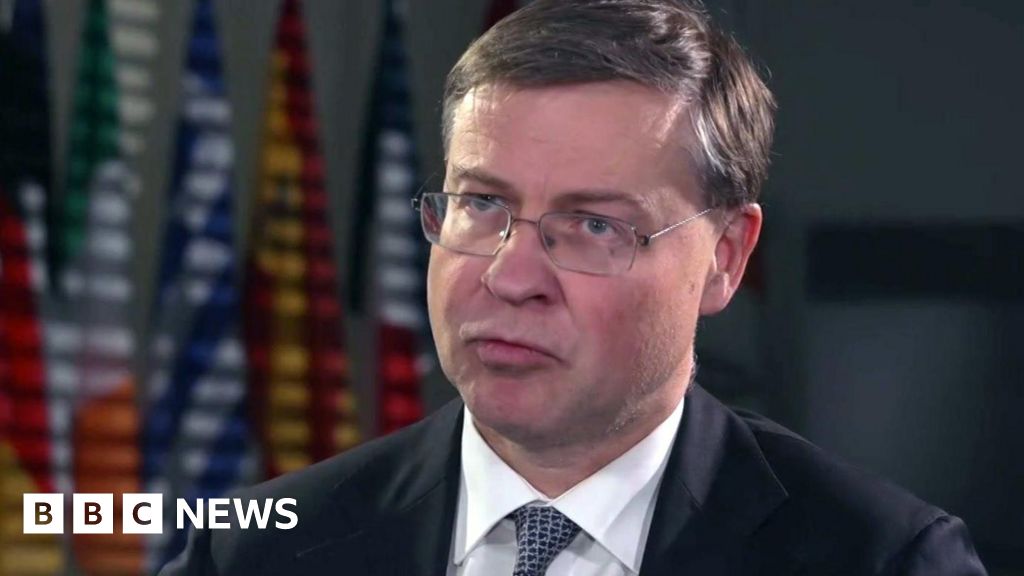
Door is open to customs union talks with UK, EU Commissioner saysImage Credit: BBC Business (Finance)
Key Points
- •BRUSSELS – The European Union has signalled a significant opening for a reset of its post-Brexit trading relationship with the United Kingdom, with a top official stating Brussels is prepared to discuss a new customs union. The comments from European Commission Executive Vice-President Valdis Dombrovskis represent the most explicit invitation to date for the UK to revisit the core terms of its trade deal, a move that could dramatically reduce economic friction but would require a major political shift in London.
- •Current Reality: The TCA, while preventing tariffs, created significant non-tariff barriers. These include customs declarations, rules of origin checks, regulatory hurdles, and sanitary and phytosanitary (SPS) inspections for agri-food products.
- •Economic Impact: The UK's Office for Budget Responsibility (OBR) has consistently forecast that the TCA will reduce the country's long-run productivity by 4% compared to EU membership, with new trade barriers depressing import and export volumes.
- •Political Context: The previous UK government's "Global Britain" strategy was predicated on diverging from EU rules and signing bespoke trade agreements worldwide. A customs union would fundamentally reverse this core principle, making this a politically charged issue within the UK.
- •The Benefits: The primary advantage is the elimination of most customs paperwork and rules of origin checks for goods traded within the union. This would vastly simplify UK-EU trade, reduce administrative costs for businesses, and speed up supply chains.
Door is open to customs union talks with UK, EU Commissioner says
BRUSSELS – The European Union has signalled a significant opening for a reset of its post-Brexit trading relationship with the United Kingdom, with a top official stating Brussels is prepared to discuss a new customs union. The comments from European Commission Executive Vice-President Valdis Dombrovskis represent the most explicit invitation to date for the UK to revisit the core terms of its trade deal, a move that could dramatically reduce economic friction but would require a major political shift in London.
In a statement to the BBC, Dombrovskis, who also serves as the EU's Trade Commissioner, confirmed the bloc's readiness to engage should the UK government wish to pursue a closer economic alignment. His remarks are being closely watched by financial markets and business leaders, who have long grappled with the costs and complexities introduced by the current Trade and Cooperation Agreement (TCA).
Asked directly about a new agreement, Dombrovskis said, "We are open for further discussions, we know the prime minister has expressed interest, actually, to come back to this issue, and there is certainly openness from the EU side for this."
This statement effectively places the diplomatic ball in the UK's court, creating a potential pathway to mitigate many of the trade barriers that have defined the post-Brexit landscape.
The Bigger Picture: A Shift in a Frozen Relationship
The EU's overture comes after years of a largely static, and often strained, relationship governed by the TCA. Finalised in late 2020, the TCA established a zero-tariff, zero-quota trade relationship but fell short of the frictionless trade the UK enjoyed as an EU member. This "harder" form of Brexit was a deliberate choice by the previous Conservative government to prioritise regulatory autonomy and the ability to strike independent trade deals.
Dombrovskis's comments acknowledge a perceived change in tone from London, suggesting that the current UK leadership may be more pragmatic about the economic trade-offs of its current arrangement.
-
Current Reality: The TCA, while preventing tariffs, created significant non-tariff barriers. These include customs declarations, rules of origin checks, regulatory hurdles, and sanitary and phytosanitary (SPS) inspections for agri-food products.
-
Economic Impact: The UK's Office for Budget Responsibility (OBR) has consistently forecast that the TCA will reduce the country's long-run productivity by 4% compared to EU membership, with new trade barriers depressing import and export volumes.
-
Political Context: The previous UK government's "Global Britain" strategy was predicated on diverging from EU rules and signing bespoke trade agreements worldwide. A customs union would fundamentally reverse this core principle, making this a politically charged issue within the UK.
What is a Customs Union?
For businesses and policymakers, understanding the precise nature of a customs union is critical. It represents a much deeper level of economic integration than a standard free trade agreement, but it is not the same as the EU's Single Market.
A customs union involves member countries removing tariffs among themselves and agreeing to apply a common set of tariffs to all goods imported from outside the union.
Key Features and Trade-Offs
-
The Benefits: The primary advantage is the elimination of most customs paperwork and rules of origin checks for goods traded within the union. This would vastly simplify UK-EU trade, reduce administrative costs for businesses, and speed up supply chains.
-
The Drawbacks: The UK would lose its independent trade policy. It would be unable to set its own tariffs or sign comprehensive free trade deals with countries like the United States, Australia, or members of the CPTPP bloc, as it would be bound by the EU's common external tariff.
-
The Single Market Distinction: A customs union primarily deals with goods. It does not grant access to the EU's Single Market for services, nor does it require the free movement of people. Turkey, for example, is in a customs union with the EU for certain goods but is not a member of the Single Market.
The Northern Ireland Connection
Any discussion of a new customs arrangement is inextricably linked to the complex situation in Northern Ireland. The Windsor Framework was designed to manage the trade border in the Irish Sea, which was created because Northern Ireland remained aligned with the EU's Single Market for goods to avoid a hard land border with the Republic of Ireland.
A UK-wide customs union with the EU could fundamentally alter this dynamic.
-
The Windsor Framework: A UK-EU customs union would eliminate the core justification for most customs checks between Great Britain and Northern Ireland. With a common external tariff applied by both the UK and the EU, there would be little to no risk of non-compliant goods entering the EU's Single Market via Northern Ireland.
-
Simplification: While some regulatory (SPS) checks might remain depending on the deal's scope, a customs union would resolve the most contentious customs issues that have plagued Northern Ireland trade post-Brexit.
Implications and The Road Ahead
Dombrovskis's statement is not a formal offer but a clear diplomatic signal. The immediate response and long-term viability of this opening depend almost entirely on the political appetite and strategy of the UK government.
Business groups, particularly those in the manufacturing, automotive, and agri-food sectors, have long advocated for measures to reduce trade friction with the EU, their largest trading partner. Many would welcome the operational simplicity and cost savings a customs union would bring.
-
Business Perspective: Industry bodies like the Confederation of British Industry (CBI) and the British Chambers of Commerce have consistently highlighted the burdens of the current TCA. A move towards a customs union aligns with their calls for a closer economic relationship to boost investment and growth.
-
Political Hurdles: For the UK government, pursuing this path would be a high-stakes decision. It would be portrayed by Brexit supporters as a reversal of a key sovereignty gain and a step back towards EU alignment. Any negotiation would require immense political capital to navigate the domestic debate.
-
What to Watch: The focus now shifts to Downing Street. The key indicator will be whether the UK Prime Minister formally or informally signals a desire to open exploratory talks. The EU has confirmed its door is open; the world is now waiting to see if the UK is willing to walk through it. A formal review of the TCA is scheduled for 2026, providing a natural window for any potential renegotiation to take place.
Source: BBC Business (Finance)
Related Articles
Nationwide Protests Against ICE Enforcement Erupt in U.S.
Thousands are protesting ICE after the DOJ declined to investigate a fatal agent-involved shooting in Minneapolis, fueling a national movement and public anger.
Venezuela Amnesty Bill Could Free Political Prisoners
Learn about Venezuela's proposed amnesty bill to release political prisoners. The move could signal a major political shift and affect future economic sanctions
Pokémon Cancels Yasukuni Shrine Event After Backlash
The Pokémon Company has canceled an event at Tokyo's controversial Yasukuni Shrine after facing international backlash from China and South Korea.
US to Lose Measles Elimination Status: What It Means
The U.S. is poised to lose its measles elimination status due to escalating outbreaks. Learn what this downgrade means for public health and the economy.