Dimon's 2008 Threat to UK Govt Revealed by Faisal Islam
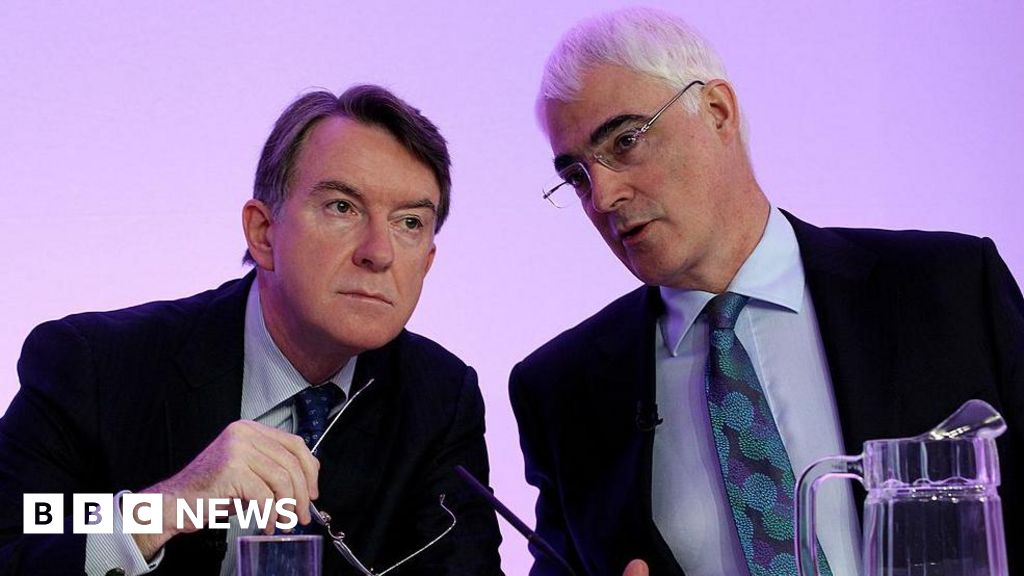
Faisal Islam: Mandelson, Darling and the conversation I can't forgetImage Credit: BBC Business (Finance)
Key Points
- •LONDON – In the crucible of the 2008 global financial crisis, as governments scrambled to prevent a systemic collapse, a private conversation laid bare the raw power dynamics between a sovereign nation and the titans of global finance. A newly surfaced account from senior journalist Faisal Islam reveals a moment of intense pressure, where JPMorgan Chase CEO Jamie Dimon confronted two of Britain's most senior ministers, Peter Mandelson and Alistair Darling, with a stark choice regarding the future of his bank's investment in the UK.
- •Government Under Pressure: Alistair Darling, as Chancellor of the Exchequer, and Peter Mandelson, as Business Secretary, were at the heart of the UK's response. They had nationalised Northern Rock and orchestrated bailouts for RBS and Lloyds Banking Group. Public debt was soaring to fund these interventions.
- •The Bank Bonus Levy: A key point of contention was the government's introduction of a one-off 50% tax on any bank bonus over £25,000. This was a politically popular move, designed to show that bankers were contributing to the recovery and to quell public outrage. For the banks, however, it was seen as a punitive and targeted attack that threatened London's competitiveness as a global financial hub.
- •Dependence on Debt Markets: To fund the bailouts and a growing budget deficit, the UK Treasury had to issue unprecedented amounts of government bonds, or "gilts." The success of these debt auctions depended entirely on the willingness of large institutional investors, like JPMorgan Chase, to buy them. Any suggestion that a major buyer might withdraw from the market could trigger a catastrophic loss of confidence, sending the UK's borrowing costs spiralling.
- •Sovereign vs. Corporate Power: The incident illustrates the immense leverage held by a global financial institution over a G7 nation. Dimon's threat targeted two core pillars of the UK's economic health: the stability of its government debt market and its status as a premier destination for foreign direct investment.
Faisal Islam: Mandelson, Darling and the conversation I can't forget
LONDON – In the crucible of the 2008 global financial crisis, as governments scrambled to prevent a systemic collapse, a private conversation laid bare the raw power dynamics between a sovereign nation and the titans of global finance. A newly surfaced account from senior journalist Faisal Islam reveals a moment of intense pressure, where JPMorgan Chase CEO Jamie Dimon confronted two of Britain's most senior ministers, Peter Mandelson and Alistair Darling, with a stark choice regarding the future of his bank's investment in the UK.
The confrontation, recalled by Islam, serves as a potent reminder of the precarious balancing act the UK government faced: placating public fury directed at the banking sector while simultaneously depending on that very sector for the nation's economic stability.
The Confrontation: A High-Stakes Exchange
The incident occurred at the height of global financial turmoil. The UK government, led by Labour's Gordon Brown, was navigating the fallout from bank bailouts and introducing policies aimed at curbing the bonus culture that many blamed for the crisis.
According to Islam's recollection of the tense meeting, Mr. Dimon, head of one of the few major US banks to weather the crisis with relative stability, was direct and unambiguous in his frustration with UK policy.
"Mr Dimon was very, very angry," Islam wrote. "He said that his bank bought a lot of UK debt and he wondered if that was now such a good idea."
This was not a veiled suggestion; it was a direct challenge to the UK's ability to fund its own crisis response.
The threat escalated. Dimon reportedly continued, "He went on to say they were thinking of building a new office in London but they had to reconsider that now."
Islam noted his own retort in the moment, pointing out that JPMorgan's purchases of UK debt were not an act of charity but "a good business deal for them." This highlights the transactional nature of the relationship, yet it did not dilute the gravity of Dimon's message.
Context: A Nation on the Brink
To understand the weight of Dimon's words, one must revisit the economic landscape of late 2008 and 2009.
Government Under Pressure: Alistair Darling, as Chancellor of the Exchequer, and Peter Mandelson, as Business Secretary, were at the heart of the UK's response. They had nationalised Northern Rock and orchestrated bailouts for RBS and Lloyds Banking Group. Public debt was soaring to fund these interventions.
The Bank Bonus Levy: A key point of contention was the government's introduction of a one-off 50% tax on any bank bonus over £25,000. This was a politically popular move, designed to show that bankers were contributing to the recovery and to quell public outrage. For the banks, however, it was seen as a punitive and targeted attack that threatened London's competitiveness as a global financial hub.
Dependence on Debt Markets: To fund the bailouts and a growing budget deficit, the UK Treasury had to issue unprecedented amounts of government bonds, or "gilts." The success of these debt auctions depended entirely on the willingness of large institutional investors, like JPMorgan Chase, to buy them. Any suggestion that a major buyer might withdraw from the market could trigger a catastrophic loss of confidence, sending the UK's borrowing costs spiralling.
Analysis: The Unseen Levers of Power
The exchange between Dimon, Darling, and Mandelson was more than a heated debate; it was a microcosm of the fundamental tensions that define the relationship between modern governments and multinational finance.
-
Sovereign vs. Corporate Power: The incident illustrates the immense leverage held by a global financial institution over a G7 nation. Dimon's threat targeted two core pillars of the UK's economic health: the stability of its government debt market and its status as a premier destination for foreign direct investment.
-
The Gilt Market's Importance: The threat to reconsider buying UK debt was the more immediate and potent weapon. A failed gilt auction during the crisis would have been an economic cataclysm, signalling to the world that Britain could not finance itself. This underscores the critical, and often unseen, role that primary dealers like JPMorgan play in a country's fiscal operations.
-
London's Fragile Status: The second threat, to reconsider a new London office, spoke to a longer-term concern that persists today. The value of the City of London to the UK economy is immense. The government was—and remains—acutely aware that policy decisions, particularly on taxation and regulation, can drive mobile global capital to rival financial centres like New York, Frankfurt, or Singapore.
Legacy and Modern Parallels
In the years following the crisis, the immediate threats did not fully materialise. JPMorgan Chase continued to be a major buyer of UK gilts and, in 2010, proceeded with the acquisition of a large office at 25 Bank Street in Canary Wharf, which became its European headquarters.
However, the conversation that Faisal Islam "can't forget" remains profoundly relevant. The core dilemma it exposed has reappeared in different forms.
Post-Brexit Britain: The UK's relationship with global finance has been a central theme of the post-Brexit era. The government has sought to enhance the City's competitiveness through regulatory reforms (the "Edinburgh Reforms") while navigating a new economic reality outside the European Union. The debate over how to balance attractive tax and regulatory regimes with domestic political and social needs is ongoing.
Corporate Tax Debates: Recent discussions around windfall taxes on energy companies and ongoing debates over the UK's corporation tax rate echo the same fundamental tension. Policymakers must constantly weigh the potential revenue and political gains of higher taxes against the risk of discouraging investment and prompting corporations to relocate.
This historical anecdote, brought to light by Islam, is a stark lesson in realpolitik. It demonstrates that behind the public pronouncements and policy papers, the business of running a country in a globalised world often involves high-stakes, closed-door negotiations where a nation's economic trajectory can be powerfully influenced by the strategic decisions of a handful of key corporate actors. The balance of power remains a delicate and ever-shifting frontier.
Source: BBC Business (Finance)
Related Articles
Nationwide Protests Against ICE Enforcement Erupt in U.S.
Thousands are protesting ICE after the DOJ declined to investigate a fatal agent-involved shooting in Minneapolis, fueling a national movement and public anger.
Venezuela Amnesty Bill Could Free Political Prisoners
Learn about Venezuela's proposed amnesty bill to release political prisoners. The move could signal a major political shift and affect future economic sanctions
Pokémon Cancels Yasukuni Shrine Event After Backlash
The Pokémon Company has canceled an event at Tokyo's controversial Yasukuni Shrine after facing international backlash from China and South Korea.
US to Lose Measles Elimination Status: What It Means
The U.S. is poised to lose its measles elimination status due to escalating outbreaks. Learn what this downgrade means for public health and the economy.