Florida Iguanas 'Cold Stunned' & Falling From Trees
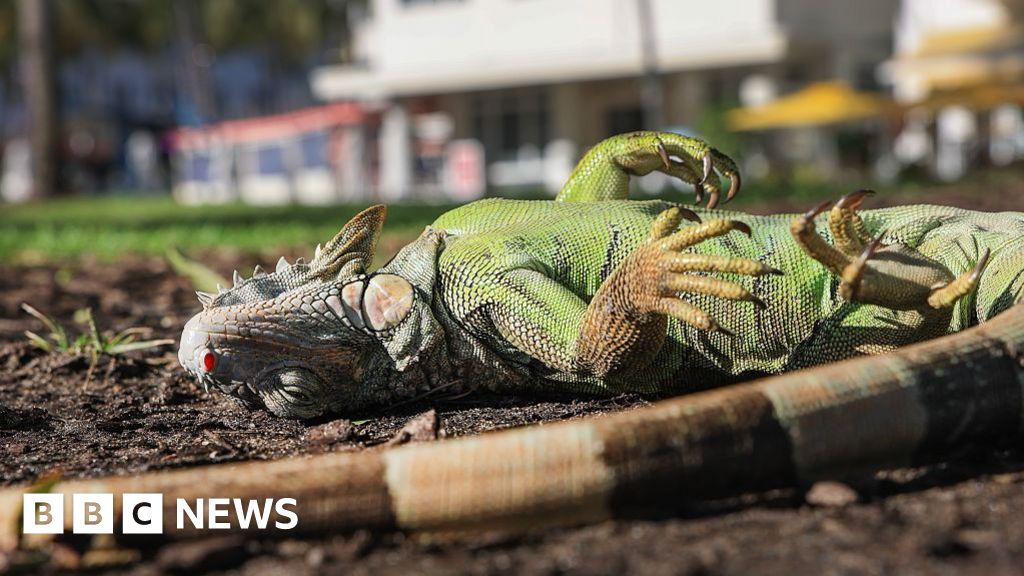
Florida iguanas are 'cold stunned' and falling from treesImage Credit: BBC News
Key Points
- •MIAMI – A rare plunge in Florida's temperatures has created a bizarre spectacle of iguanas falling from trees, paralyzed by the cold. But for state officials, municipal managers, and private property owners, this strange phenomenon represents a significant and unexpected economic opportunity in the costly, long-running battle against one of the state's most destructive invasive species.
- •Infrastructure Under Siege: Iguanas are prolific burrowers. Their elaborate tunnel systems, often dug alongside waterways, compromise the structural integrity of seawalls, canal banks, and levees. The city of West Palm Beach, for example, has previously estimated spending upwards of $1.8 million on repairs to a single dam damaged by iguana burrows. These costs are ultimately borne by taxpayers through municipal budgets.
- •Damage to Private and Commercial Property: The reptiles cause significant damage to residential and commercial landscaping, consuming valuable ornamental plants, flowers, and vegetable gardens. Their corrosive droppings foul patios, pool decks, and boats, creating sanitation issues and requiring constant, costly cleaning. For businesses like resorts and golf courses, maintaining an "iguana-free" environment is a significant operational expense.
- •Utility and Transportation Disruptions: Iguanas frequently climb utility poles and electrical transformers, causing short circuits that lead to power outages. These disruptions result in direct repair costs for utility providers and lost productivity for businesses. Their burrowing habits also undermine sidewalks and road foundations, leading to premature cracking and collapse, which accelerates public works spending.
- •A Natural Cost-Saving Event: The cold weather accomplishes the most difficult part of the trapping process—immobilization—for free. This allows for manual removal without the need for expensive traps, bait, or the labor-hours associated with tracking and cornering the highly mobile animals. The FWC's call for public assistance further reduces the fiscal burden on the state by leveraging citizen volunteers, effectively deputizing the public in a large-scale pest removal operation.
Florida Iguanas Are 'Cold Stunned' and Falling From Trees
MIAMI – A rare plunge in Florida's temperatures has created a bizarre spectacle of iguanas falling from trees, paralyzed by the cold. But for state officials, municipal managers, and private property owners, this strange phenomenon represents a significant and unexpected economic opportunity in the costly, long-running battle against one of the state's most destructive invasive species.
The cold snap, which saw temperatures dip below 50°F (10°C) across South Florida, has effectively created a natural, no-cost containment event. Iguanas, as ectothermic or "cold-blooded" reptiles, rely on external heat to regulate their body temperature. When the ambient air gets too cold, their metabolism slows dramatically, rendering them immobile in a state known as "cold stunning."
This temporary paralysis is being treated as a windfall by Florida's Fish and Wildlife Conservation Commission (FWC). The agency has issued a public call to action, encouraging residents to capture the immobilized reptiles while they are vulnerable. The effort is essentially a state-sanctioned, crowdsourced pest control initiative, with initial reports indicating that over 2,000 stunned iguanas have already been removed and turned over to authorities.
An Unforeseen Subsidy in a Costly Battle
While the sight of falling iguanas is a curiosity, the underlying issue is a serious economic liability. The green iguana, not native to Florida, has proliferated to the point of infestation in the southern parts of the state, inflicting millions of dollars in damages annually. The current cold snap provides a temporary, but crucial, advantage in mitigating these costs.
The financial burden of the iguana population is multifaceted, impacting public infrastructure, private property, and key local industries.
-
Infrastructure Under Siege: Iguanas are prolific burrowers. Their elaborate tunnel systems, often dug alongside waterways, compromise the structural integrity of seawalls, canal banks, and levees. The city of West Palm Beach, for example, has previously estimated spending upwards of $1.8 million on repairs to a single dam damaged by iguana burrows. These costs are ultimately borne by taxpayers through municipal budgets.
-
Damage to Private and Commercial Property: The reptiles cause significant damage to residential and commercial landscaping, consuming valuable ornamental plants, flowers, and vegetable gardens. Their corrosive droppings foul patios, pool decks, and boats, creating sanitation issues and requiring constant, costly cleaning. For businesses like resorts and golf courses, maintaining an "iguana-free" environment is a significant operational expense.
-
Utility and Transportation Disruptions: Iguanas frequently climb utility poles and electrical transformers, causing short circuits that lead to power outages. These disruptions result in direct repair costs for utility providers and lost productivity for businesses. Their burrowing habits also undermine sidewalks and road foundations, leading to premature cracking and collapse, which accelerates public works spending.
The Economics of Eradication
Managing Florida's iguana population is a year-round, capital-intensive endeavor. The current cold-stun event offers a stark contrast to the standard, high-cost methods of control.
Professional wildlife trappers in South Florida command significant fees for iguana removal, with services ranging from several hundred dollars for a single property assessment to thousands for ongoing trapping and exclusion services. Municipalities and large property management associations often retain these services on expensive annual contracts.
The cold snap disrupts this model by democratizing the removal process.
-
A Natural Cost-Saving Event: The cold weather accomplishes the most difficult part of the trapping process—immobilization—for free. This allows for manual removal without the need for expensive traps, bait, or the labor-hours associated with tracking and cornering the highly mobile animals. The FWC's call for public assistance further reduces the fiscal burden on the state by leveraging citizen volunteers, effectively deputizing the public in a large-scale pest removal operation.
-
Quantifying the Opportunity: While a precise figure is difficult to calculate, every iguana removed by a citizen is one less that needs to be professionally trapped. If thousands are removed during this cold snap, the implied savings for homeowners and local governments could easily reach into the hundreds ofthousands of dollars in the short term.
Broader Economic Context
The same weather system impacting the iguanas is also a source of concern for Florida's multi-billion dollar agricultural sector. Citrus, strawberry, and tomato growers have been deploying their own costly measures—including irrigation and protective coverings—to shield crops from the frost. This highlights the dual nature of the cold front: a threat to one sector of the state's economy and an unexpected subsidy for another.
Furthermore, the state's encouragement to capture the iguanas touches on a niche but growing "iguana economy." As an invasive species, they can be humanely euthanized and disposed of. Some entrepreneurs and residents process them for meat, which is considered a delicacy in parts of Central and South America. This provides a sustainable, no-cost disposal method that aligns with the FWC's management goals.
The Bottom Line
The 2024 cold-stun event will not solve Florida's iguana problem. The reptiles that survive—those that found warm refuge or were in more sheltered areas—will quickly resume breeding once temperatures rise. The population is resilient, and long-term, sustained management efforts will remain a financial necessity.
However, this event serves as a powerful case study in the economic dynamics of invasive species management. It demonstrates how a natural weather event can temporarily shift the cost-benefit analysis of pest control, providing significant, albeit temporary, fiscal relief.
For now, as stunned reptiles are collected from lawns and roadsides, municipal budget managers and property owners are experiencing a brief respite in a war that is otherwise fought year-round with checkbooks and trapping contracts. The focus will soon shift back to long-term strategies, but the financial impact of this cold-induced iguana roundup will be a welcome, if unusual, entry on the state's environmental and economic ledger.
Source: BBC News
Related Articles
Nationwide Protests Against ICE Enforcement Erupt in U.S.
Thousands are protesting ICE after the DOJ declined to investigate a fatal agent-involved shooting in Minneapolis, fueling a national movement and public anger.
Venezuela Amnesty Bill Could Free Political Prisoners
Learn about Venezuela's proposed amnesty bill to release political prisoners. The move could signal a major political shift and affect future economic sanctions
Pokémon Cancels Yasukuni Shrine Event After Backlash
The Pokémon Company has canceled an event at Tokyo's controversial Yasukuni Shrine after facing international backlash from China and South Korea.
US to Lose Measles Elimination Status: What It Means
The U.S. is poised to lose its measles elimination status due to escalating outbreaks. Learn what this downgrade means for public health and the economy.