India's Strawberry Farming Goes High-Tech for Self-Reliance
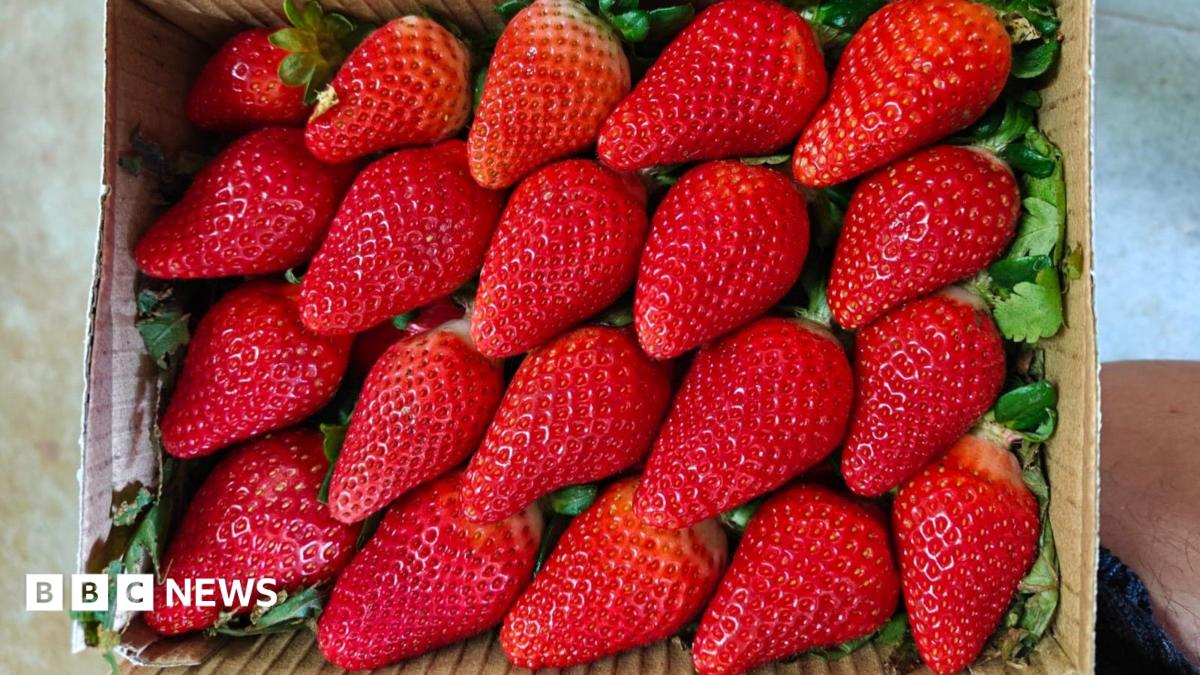
India wants to cuts its reliance on overseas strawberry varietiesImage Credit: BBC Business (Finance)
Key Points
- •BBC Business (Finance)
- •Variety Diversification: To break the reliance on standard imports, Sodha's facility is a living laboratory. "We have trialed 19 different varieties, including rare Japanese ones, and we are the only ones in India trailing a specific Netherlands variety this season," he notes. This research is critical to finding cultivars perfectly suited to Indian conditions and consumer tastes.
- •Flavor Engineering: Berry Fresh Agrotech precisely controls water intake, limiting each plant to just 75ml per day. This strategic stress produces "rich, highly concentrated sugars and aromas instead of water-logged, bland fruits," turning a cultivation variable into a tool for quality control.
- •Data-Driven Nutrition: Sodha's team conducts regular "blood work" on the crops, sending leaf and petiole samples for laboratory analysis. This provides an exact measurement of nutrient uptake, allowing them to tailor the fertigation formula with scientific precision.
- •Year-Round Production: By using semi-open polyhouses, the farm has eliminated seasonality. "It's not a seasonal fruit for us," Sodha states, a paradigm shift for a crop traditionally available for only a few months.
India Wants to Cut Its Reliance on Overseas Strawberry Varieties
BBC Business (Finance)
A quiet revolution is taking root in India's strawberry fields. Spurred by unpredictable weather and a long-standing dependence on foreign plant varieties, a new generation of farmers and entrepreneurs is turning to high-technology and innovative business models to seize control of their harvest. From AI-powered weather forecasting to advanced hydroponics, these efforts are aimed at building a more resilient, profitable, and self-sufficient strawberry industry.
The Tyranny of Weather and Imports
For decades, India's strawberry production, centered in the hill station of Mahabaleshwar, has been a gamble. The industry relies heavily on a handful of American varieties, first introduced in the early 1990s, and is acutely vulnerable to the climate.
Ketan Yashwant Sodha, founder and CEO of Berry Fresh Agrotech, knows the risks of traditional open-field farming all too well. "For the past 10 years, it has consistently rained in India during our peak season - November, December, and the first week of January," he says. "When you are in an open field and your plantation is at its absolute peak, a single rain will ruin your entire crop."
This vulnerability has created a powerful incentive to innovate, pushing pioneering farmers to invest in systems that offer control over every variable of cultivation.
The High-Tech Solution: Precision Hydroponics
In 2022, after years of frustration with weather-related losses, Sodha pivoted to hydroponics—a method of soilless cultivation within a protected environment. The transition was punishing.
"I suffered immense losses and failed multiple times," Sodha admits. "The soil is forgiving; hydroponics does not forgive. If you make a mistake today, you will wake up tomorrow morning to a disaster."
However, these hard-won lessons have paved the way for a highly sophisticated and data-driven farming operation. His team now employs a suite of advanced techniques to produce high-quality berries year-round.
-
Variety Diversification: To break the reliance on standard imports, Sodha's facility is a living laboratory. "We have trialed 19 different varieties, including rare Japanese ones, and we are the only ones in India trailing a specific Netherlands variety this season," he notes. This research is critical to finding cultivars perfectly suited to Indian conditions and consumer tastes.
-
Flavor Engineering: Berry Fresh Agrotech precisely controls water intake, limiting each plant to just 75ml per day. This strategic stress produces "rich, highly concentrated sugars and aromas instead of water-logged, bland fruits," turning a cultivation variable into a tool for quality control.
-
Data-Driven Nutrition: Sodha's team conducts regular "blood work" on the crops, sending leaf and petiole samples for laboratory analysis. This provides an exact measurement of nutrient uptake, allowing them to tailor the fertigation formula with scientific precision.
-
Year-Round Production: By using semi-open polyhouses, the farm has eliminated seasonality. "It's not a seasonal fruit for us," Sodha states, a paradigm shift for a crop traditionally available for only a few months.
From Pilot to Production: The Investment Blueprint
With a proven model, Sodha is now seeking capital to expand. "We have built the trial facility, written the SOPs (standard operating procedures), and designed the farm manual," he explains. "We are talking to investors to expand to a five-acre facility that will accommodate 200,000 plants."
This move represents a broader trend in Indian agri-tech, where successful pilot projects are being packaged as scalable, investment-ready enterprises, attracting interest from venture capital looking for sustainable and technology-driven food production models.
Community-Led Innovation in Mahabaleshwar
While individual entrepreneurs forge ahead, established farming communities are also embracing technology, albeit through a different, collective model. Krishan Bhilare, whose family has farmed strawberries in Mahabaleshwar for generations, is part of a Farmer Producer Organisation (FPO) leveraging technology to empower its members.
He recalls the awe inspired by the first American varieties in 1992, but his focus now is on future-proofing the local industry.
-
AI-Powered Precision: The FPO has installed weather-monitoring towers across its members' lands. "The system employs AI, which uses the weather data to pinpoint when rain will strike," Bhilare says. This allows farmers to delay spraying expensive chemicals that would otherwise be washed away, saving significant costs.
-
Vertical Farming: To combat land constraints, the FPO is building vertical towers that grow strawberries in a coco-peat substrate. "By stacking five pots into a single vertical tower, we can scale our density from 25,000 plants to 125,000 plants per acre," Bhilare explains. "We are effectively multiplying our production footprint by five times on the exact same piece of land."
The High-Stakes Reality for Small Farmers
For all its promise, the high cost of technology remains a formidable barrier for many smallholders. Sheetal Danavle’s experience serves as a cautionary tale. In 2017, she and her husband invested in a hydroponic system.
"The experiment was 100% successful and the fruits we grew were entirely organic," she recalls. "It saved us a lot of labour... and it saved us a lot of money on medicines and field manure."
Their success was cut short by a massive cyclone that "completely knocked down our entire hydroponic setup." Lacking the capital to rebuild, they were forced to abandon the project. "Then we did not have the courage to set it up again," she says.
Undeterred, Danavle innovated in a different way, shifting her focus from production technology to business strategy.
- Direct-to-Consumer Entrepreneurship: "I took help of social media," she says. "I post videos of how one can grow strawberries and invite tourists to visit my strawberry farm, learn and pick the fruit. They directly now buy from the farm." This model has helped her cut out the middleman, increase profits, and build a new identity as a social media influencer and agri-entrepreneur.
The Road Ahead: A Trifecta of Innovation
The Indian strawberry sector stands at a crossroads, with three distinct paths to modernization emerging: the venture-backed, high-tech enterprise; the community-driven, cooperative tech model; and the agile, direct-to-consumer small business.
The ultimate goal is shared: to create a domestic industry that is less susceptible to climate shocks and less dependent on foreign intellectual property. The success of pioneers like Sodha may pave the way for new, commercially viable Indian strawberry varieties. Meanwhile, the efforts of FPOs like Bhilare's are crucial for ensuring that technological benefits are distributed more equitably among traditional farmers.
As these models mature, the key challenge will be de-risking investment and making advanced technology accessible and affordable. If successful, India could transform its strawberry production from a seasonal, high-risk gamble into a stable, year-round, and increasingly indigenous agricultural success story.
Source: BBC Business (Finance)
Related Articles
Nationwide Protests Against ICE Enforcement Erupt in U.S.
Thousands are protesting ICE after the DOJ declined to investigate a fatal agent-involved shooting in Minneapolis, fueling a national movement and public anger.
Venezuela Amnesty Bill Could Free Political Prisoners
Learn about Venezuela's proposed amnesty bill to release political prisoners. The move could signal a major political shift and affect future economic sanctions
Pokémon Cancels Yasukuni Shrine Event After Backlash
The Pokémon Company has canceled an event at Tokyo's controversial Yasukuni Shrine after facing international backlash from China and South Korea.
US to Lose Measles Elimination Status: What It Means
The U.S. is poised to lose its measles elimination status due to escalating outbreaks. Learn what this downgrade means for public health and the economy.