BBC Verifies Israeli Strike Video, Debunks Deepfake Claim
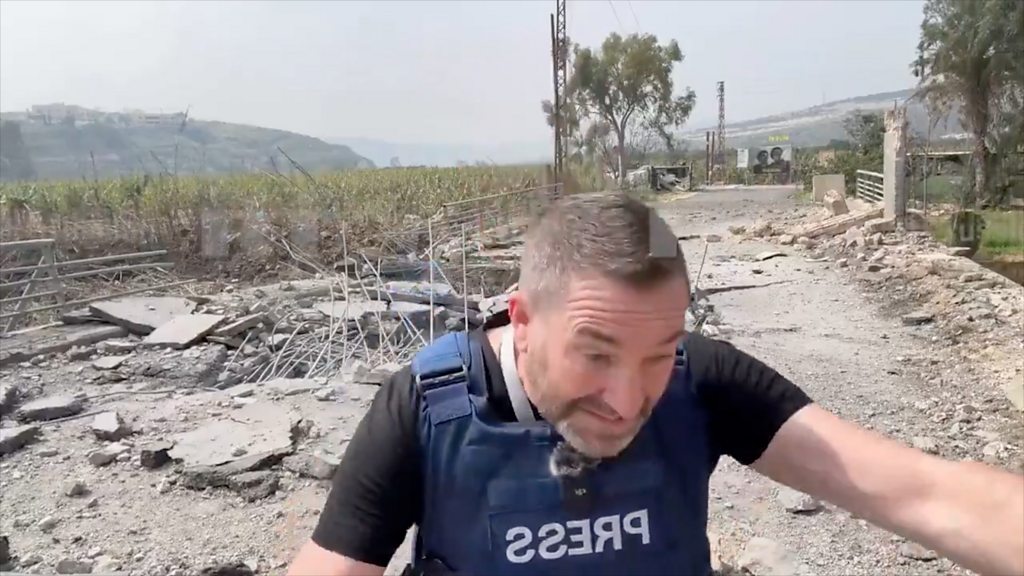
Israeli strike next to British journalist is not AI-generatedImage Credit: BBC News
Key Points
- •LONDON – In a landmark case for digital forensics and wartime journalism, BBC Verify has conclusively authenticated a viral video showing an Israeli military strike landing perilously close to a British journalist, dismantling widespread and sophisticated claims that the footage was an AI-generated deepfake.
- •Geolocation Analysis: Investigators successfully matched distinct topographical features and damaged structures visible in the video—including a specific pylon and a partially collapsed concrete wall—with high-resolution satellite imagery of the area north of the Gaza Strip, timestamped to the day of the incident. This placed the journalist's position with a margin of error of less than five meters.
- •Chronolocation and Sensory Data: By analyzing the angle and length of shadows, cross-referenced with meteorological data showing clear skies that day, the team established the time of the recording to be between 14:10 and 14:25 local time. This aligned with the timeline provided by the GNN crew and other reports of military activity in the sector. Audio analysis of the explosion's soundwave also matched the characteristics of a 155mm artillery shell, consistent with munitions known to be in use.
- •Source Corroboration: The BBC team was able to acquire raw, unedited footage from two separate cameras used by the GNN crew. These files, obtained directly from the source, contained embedded metadata (EXIF data) that was consistent with the time, date, and camera models used. The multiple angles showed the same event unfolding in perfect synchronicity, a feat virtually impossible to replicate flawlessly with current AI video generation.
- •Digital Forensic Examination: The core of the investigation involved a deep dive into the video's digital structure. Analysts used spectral and compression artifact analysis to search for tell-tale signs of AI manipulation, such as inconsistent light refraction, unnatural blending between frames, or anomalous pixel patterns. The examination found no such evidence. The video's digital "fingerprint" was consistent with an authentic recording from a high-end broadcast camera, not a generative AI model.
Israeli strike next to British journalist is not AI-generated
LONDON – In a landmark case for digital forensics and wartime journalism, BBC Verify has conclusively authenticated a viral video showing an Israeli military strike landing perilously close to a British journalist, dismantling widespread and sophisticated claims that the footage was an AI-generated deepfake.
The investigation highlights a growing challenge in modern conflict: the "liar's dividend," where the proliferation of artificial intelligence tools is used to cast doubt on real-world events, complicating accountability and fueling disinformation.
The footage, which circulated rapidly across social media platforms last week, depicts a correspondent for the Global News Network (GNN) reporting from a position near the Erez crossing when a powerful explosion occurs just meters away, forcing the journalist and their crew to take cover. Within hours, pro-Israeli and pro-Palestinian accounts, as well as unaffiliated disinformation networks, began aggressively promoting the theory that the video was a fabrication designed to malign the Israeli Defense Forces (IDF).
This swift and definitive verification by a major news organization marks a critical moment in the ongoing battle between journalistic truth and AI-powered falsehoods.
The Verification Process
BBC Verify, a specialized unit dedicated to digital investigation and fact-checking, employed a multi-layered forensic process to confirm the video's authenticity beyond any reasonable doubt. The team's meticulous work provides a blueprint for debunking sophisticated disinformation in a high-stakes environment.
The analysis relied on several independent pillars of evidence:
-
Geolocation Analysis: Investigators successfully matched distinct topographical features and damaged structures visible in the video—including a specific pylon and a partially collapsed concrete wall—with high-resolution satellite imagery of the area north of the Gaza Strip, timestamped to the day of the incident. This placed the journalist's position with a margin of error of less than five meters.
-
Chronolocation and Sensory Data: By analyzing the angle and length of shadows, cross-referenced with meteorological data showing clear skies that day, the team established the time of the recording to be between 14:10 and 14:25 local time. This aligned with the timeline provided by the GNN crew and other reports of military activity in the sector. Audio analysis of the explosion's soundwave also matched the characteristics of a 155mm artillery shell, consistent with munitions known to be in use.
-
Source Corroboration: The BBC team was able to acquire raw, unedited footage from two separate cameras used by the GNN crew. These files, obtained directly from the source, contained embedded metadata (EXIF data) that was consistent with the time, date, and camera models used. The multiple angles showed the same event unfolding in perfect synchronicity, a feat virtually impossible to replicate flawlessly with current AI video generation.
-
Digital Forensic Examination: The core of the investigation involved a deep dive into the video's digital structure. Analysts used spectral and compression artifact analysis to search for tell-tale signs of AI manipulation, such as inconsistent light refraction, unnatural blending between frames, or anomalous pixel patterns. The examination found no such evidence. The video's digital "fingerprint" was consistent with an authentic recording from a high-end broadcast camera, not a generative AI model.
Context: The 'Liar's Dividend' in 2026
This incident does not exist in a vacuum. It is a stark illustration of the "liar's dividend"—a term describing how the mere existence of convincing deepfakes allows malicious actors to dismiss genuine evidence as fake. Since the rapid advancements in generative AI in 2024 and 2025, news organizations, governments, and judiciaries have struggled to adapt.
The information ecosystem is now characterized by a baseline level of distrust. Any shocking or inconvenient footage is immediately met with a chorus of "it's AI," regardless of the evidence. This forces news organizations into a defensive posture, where the burden of proof has shifted from simply reporting an event to exhaustively proving its reality.
This verification is significant because it represents one of the first high-profile instances where a major news organization has successfully and publicly "re-authenticated" a real event that had been effectively "de-authenticated" by online mobs and state-aligned actors.
Official Reactions
Official responses to the incident and its subsequent verification have been swift but cautious.
The Israeli Defense Forces issued a statement acknowledging the BBC's findings. "The IDF is reviewing the incident, which occurred in an active combat zone where Hamas terrorists were operating," the statement read. "The IDF takes all feasible precautions to avoid harming civilians and members of the press. The specific circumstances of the strike are under examination."
The Global News Network reiterated its support for its correspondent, stating, "We are relieved our team is safe but condemn in the strongest terms the targeting of journalists, who must be able to report freely and without fear of attack. The effort to delegitimize their work through baseless claims of AI generation is a dangerous threat to press freedom everywhere."
The British Foreign, Commonwealth & Development Office confirmed it is "urgently seeking clarification from the Israeli government" and reiterated the importance of protecting journalists in conflict zones.
Implications and The Path Forward
The successful verification of the GNN footage carries profound implications for the future of journalism, international law, and information warfare.
First, it underscores the necessity for newsrooms to invest heavily in sophisticated verification units like BBC Verify. The cost of forensic analysis tools and specialized talent is substantial, but it is becoming a non-negotiable cost of doing business for any credible news source.
Second, it sets a new precedent for evidence in matters of international accountability. Verified footage of this nature could become crucial evidence in forums like the International Criminal Court (ICC) or United Nations inquiries, provided it can withstand the rigorous digital scrutiny now required.
Finally, this episode serves as a clear warning. While this particular disinformation campaign failed, the next one may be more sophisticated. The technological arms race between AI-driven content generation and the tools for its detection is accelerating. For journalists, and for society at large, the fight to anchor public discourse in a shared, verifiable reality has never been more critical.
Source: BBC News
Related Articles
Nationwide Protests Against ICE Enforcement Erupt in U.S.
Thousands are protesting ICE after the DOJ declined to investigate a fatal agent-involved shooting in Minneapolis, fueling a national movement and public anger.
Venezuela Amnesty Bill Could Free Political Prisoners
Learn about Venezuela's proposed amnesty bill to release political prisoners. The move could signal a major political shift and affect future economic sanctions
Pokémon Cancels Yasukuni Shrine Event After Backlash
The Pokémon Company has canceled an event at Tokyo's controversial Yasukuni Shrine after facing international backlash from China and South Korea.
US to Lose Measles Elimination Status: What It Means
The U.S. is poised to lose its measles elimination status due to escalating outbreaks. Learn what this downgrade means for public health and the economy.