Sperm Whales Work as a Team to Assist a Live Birth
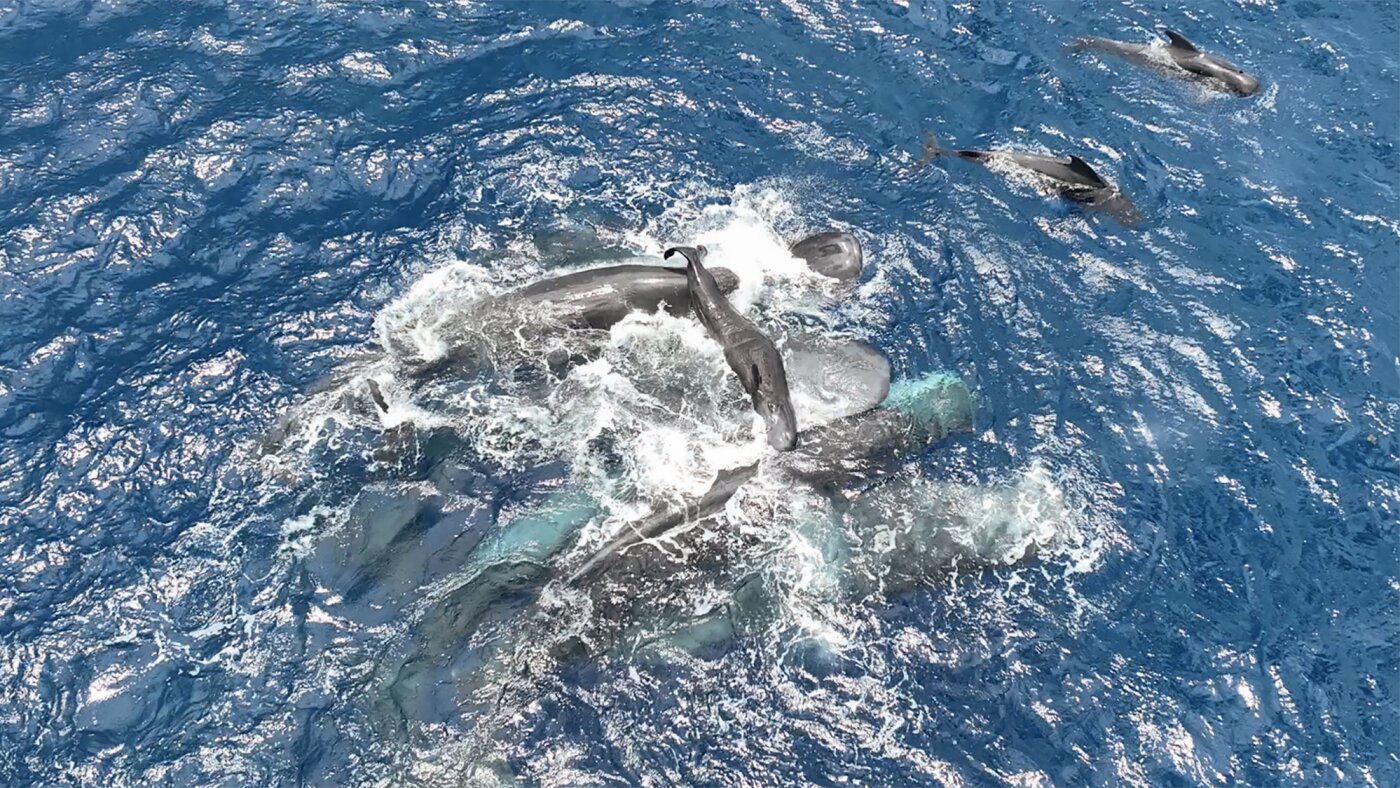
Scientists watch sperm whales work as a team to assist a birthImage Credit: NPR News
Key Points
- •LONDON – In a landmark observation that offers unprecedented insight into the complex social structures of marine life, scientists have documented a group of sperm whales cooperatively assisting in the birth of a calf. The event, captured in stunning detail by aerial drones and underwater microphones, reveals a level of coordinated social support previously unconfirmed in the species, challenging existing notions of animal behavior and kinship.
- •Advanced Surveillance: The use of aerial drones provided a continuous, non-invasive overhead view, allowing researchers to observe group dynamics and individual behaviors without disturbing the whales.
- •Acoustic Monitoring: Underwater microphones, or hydrophones, recorded the constant stream of clicks and codas the whales used to communicate, data that is central to Project CETI's mission to decipher their language.
- •Data Integration: By combining the visual footage with years of observational data and applying machine learning algorithms, the team successfully identified the mother as a whale named "Rounder."
- •Midwifery and Support: The videos show various whales, which scientists have termed "aunties," actively participating. Newborn sperm whales are negatively buoyant, meaning they sink without effort. For the first three hours post-birth, every whale present, including those not genetically related to the mother, took turns nudging and lifting the calf to the surface to ensure it could breathe.
Scientists Watch Sperm Whales Work as a Team to Assist a Birth
LONDON – In a landmark observation that offers unprecedented insight into the complex social structures of marine life, scientists have documented a group of sperm whales cooperatively assisting in the birth of a calf. The event, captured in stunning detail by aerial drones and underwater microphones, reveals a level of coordinated social support previously unconfirmed in the species, challenging existing notions of animal behavior and kinship.
The findings, published in the journals Science and Scientific Reports, provide the most detailed chronicle of a cetacean birth ever recorded and underscore the sophisticated societal dynamics at play deep beneath the ocean's surface.
An Unexpected Discovery
The discovery unfolded in July 2023 in the Caribbean Sea. A research team from Project CETI (Cetacean Translation Initiative), a non-profit research group, was tracking a sperm whale when they encountered a larger, unusually placid group of 11 individuals clustered near the surface.
Shane Gero, lead biologist for Project CETI, noted the atypical behavior. "They were just laying there calmly," he recalled, a stark contrast to their usually active and social nature.
The team deployed two aerial drones to film the group. Approximately an hour later, the scene transformed dramatically. The water began to roil, and a sudden cloud of blood appeared, initially sparking fears of a predator attack.
"To be honest, I thought that predators had attacked," Gero said. "And I was like, 'Oh no. This is going to be a horrible, terrible, no-good, very bad day."
Instead, the team was witnessing a birth. The drones captured the entire process, from the mother's labor to the moment the newborn calf emerged, tail-first, as is typical for whales. It was, Gero stated, one of the most rewarding days of his professional life.
The Science of Observation
This breakthrough was enabled by a combination of advanced technology and long-term field research.
-
Advanced Surveillance: The use of aerial drones provided a continuous, non-invasive overhead view, allowing researchers to observe group dynamics and individual behaviors without disturbing the whales.
-
Acoustic Monitoring: Underwater microphones, or hydrophones, recorded the constant stream of clicks and codas the whales used to communicate, data that is central to Project CETI's mission to decipher their language.
-
Data Integration: By combining the visual footage with years of observational data and applying machine learning algorithms, the team successfully identified the mother as a whale named "Rounder."
A Society of Helpers
The most significant finding from the observation was the intricate and highly cooperative effort demonstrated by the entire group to support both the mother and her newborn. This behavior extended beyond immediate family, revealing a complex social fabric.
-
Midwifery and Support: The videos show various whales, which scientists have termed "aunties," actively participating. Newborn sperm whales are negatively buoyant, meaning they sink without effort. For the first three hours post-birth, every whale present, including those not genetically related to the mother, took turns nudging and lifting the calf to the surface to ensure it could breathe.
-
Complex Social Structure: Sperm whales live in matrilineal societies composed of grandmothers, mothers, and daughters. Males typically leave the group in their mid-teens. While Rounder's immediate family was present, roughly half of the whales assisting in the birth belonged to a different, unrelated matrilineal line.
-
Reciprocal Altruism: Gero suggests this cooperative behavior points to a sophisticated social contract. "The behaviors that we're seeing — in supporting the mom, in supporting the newborn — reflect a complex cooperative society that can't just be explained by 'Oh, you're related,'" he explained. "There's something richer there — in which they live in a society where the expectation is 'I will help you so you will help me.'"
Context and Implications
External experts have affirmed the importance of these findings. Philippa Brakes, a behavioral ecologist at the University of Exeter and a research fellow with Whale and Dolphin Conservation, who was not involved in the studies, noted the discovery suggests a "layering of cultural and innate behaviors."
"An analogy for humans might be that some of us like sushi, others like fries — but when it comes to helping people in extremis, most of us would respond to someone who was giving birth in the street," Brakes commented, highlighting the blend of instinct and learned social response.
The observation provides compelling evidence that complex, cooperative societies are not exclusive to primates and humans. The sperm whales' actions demonstrate a community-wide investment in the survival of a newborn, regardless of direct genetic ties, which has profound implications for our understanding of social evolution.
What's Next
The research team at Project CETI will continue to analyze the vast trove of acoustic and visual data collected during the event. The primary goal is to decipher the communications that took place, which could reveal how the whales coordinated their efforts and managed the high-stakes situation.
This event serves as a powerful reminder of the deep social bonds and intelligence present in the animal kingdom. As Gero concluded, the observation carries a message that resonates far beyond marine biology.
"We succeed by overcoming obstacles by working together. In spite of the fact that we're different and unrelated," he said. "And that's a pretty important message, I think, these days."
Source: NPR News
Related Articles
Nationwide Protests Against ICE Enforcement Erupt in U.S.
Thousands are protesting ICE after the DOJ declined to investigate a fatal agent-involved shooting in Minneapolis, fueling a national movement and public anger.
Venezuela Amnesty Bill Could Free Political Prisoners
Learn about Venezuela's proposed amnesty bill to release political prisoners. The move could signal a major political shift and affect future economic sanctions
Pokémon Cancels Yasukuni Shrine Event After Backlash
The Pokémon Company has canceled an event at Tokyo's controversial Yasukuni Shrine after facing international backlash from China and South Korea.
US to Lose Measles Elimination Status: What It Means
The U.S. is poised to lose its measles elimination status due to escalating outbreaks. Learn what this downgrade means for public health and the economy.