TN Volkswagen Workers Ratify Historic First Union Contract
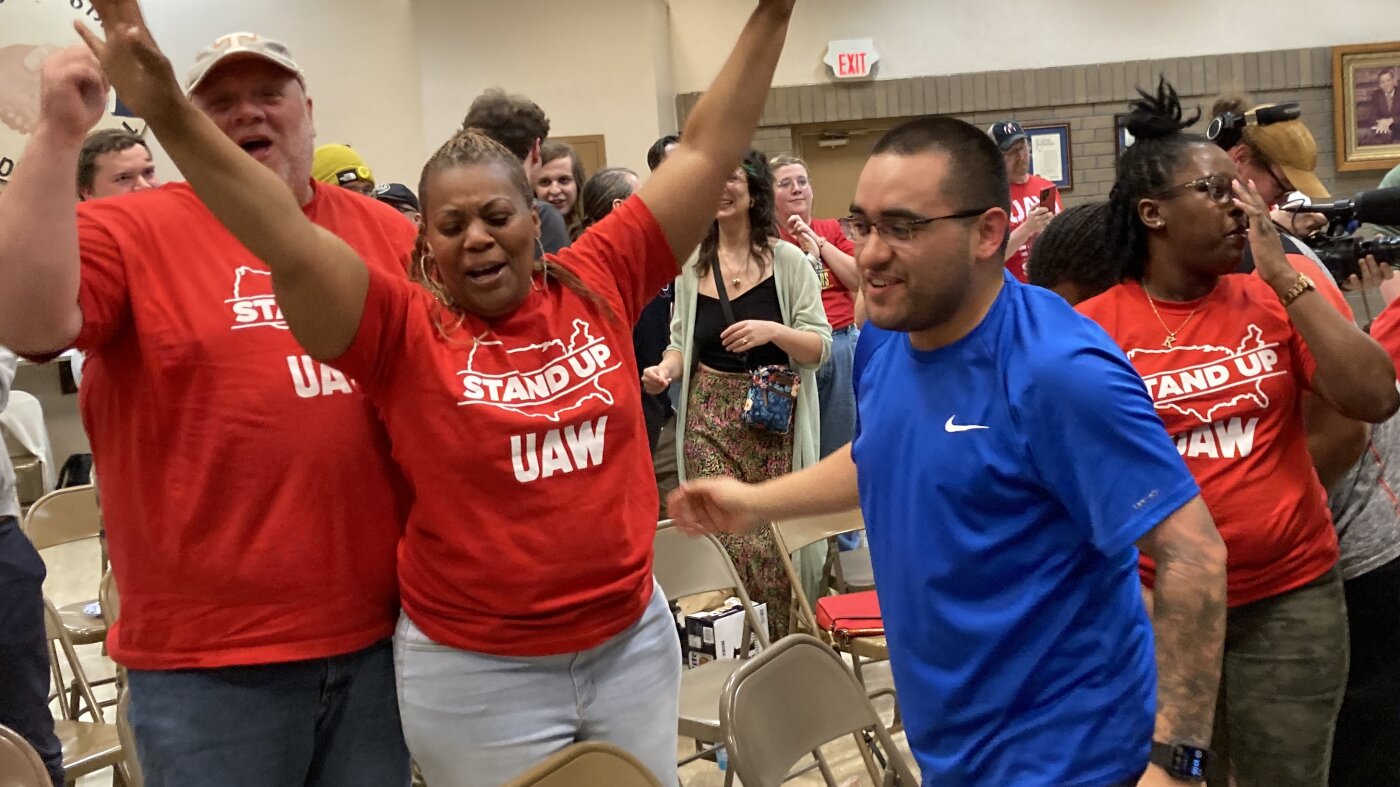
In a historic vote, Tennessee Volkswagen workers get their first union contractImage Credit: NPR Business
Key Points
- •CHATTANOOGA, TN – In a landmark decision with significant implications for the American automotive industry and the labor movement, workers at the Volkswagen plant in Chattanooga, Tennessee, have overwhelmingly voted to ratify their first-ever union contract. The vote, which saw 96% approval, solidifies a crucial victory for the United Auto Workers (UAW) and marks a pivotal moment in the union's decades-long effort to organize foreign-owned auto plants in the historically union-resistant South.
- •Immediate Financial Gains: All workers will receive an immediate ratification bonus of $6,550.
- •Substantial Wage Increases: The contract guarantees a 20% wage increase over its lifetime. By 2030, the top hourly wage will reach $39.41 for production workers and $49.86 for skilled-trades workers, such as machinists and electricians. This base wage does not include additional cost-of-living adjustments also secured in the deal.
- •Healthcare and Benefits: Employee healthcare premiums will be reduced by 20%, with some plans seeing even larger cuts. Critically, these premium rates are frozen for the next four years. Workers will also gain two additional paid days off.
- •Unprecedented Job Security: A key breakthrough in negotiations, the contract includes robust job security provisions. Volkswagen has committed to keeping the plant open for the duration of the agreement and must now hold discussions with the union before initiating any layoffs. The company also pledged to maintain sufficient production levels to ensure employment for the workforce.
In a Historic Vote, Tennessee Volkswagen Workers Get Their First Union Contract
CHATTANOOGA, TN – In a landmark decision with significant implications for the American automotive industry and the labor movement, workers at the Volkswagen plant in Chattanooga, Tennessee, have overwhelmingly voted to ratify their first-ever union contract. The vote, which saw 96% approval, solidifies a crucial victory for the United Auto Workers (UAW) and marks a pivotal moment in the union's decades-long effort to organize foreign-owned auto plants in the historically union-resistant South.
This agreement, finalized Thursday, concludes a nearly two-year negotiation process that followed a successful unionization vote in 2024. The contract delivers substantial gains in wages, benefits, and job security, establishing a new benchmark for autoworkers across the region and providing the UAW with powerful momentum for its broader organizing campaigns.
The Bottom Line: A Landmark Agreement
The newly ratified contract, which runs through February 2030, introduces a host of financial and workplace improvements that will take effect on Monday. Volkswagen management acknowledged the agreement recognizes the "hard work and dedication" of its Chattanooga team.
The economic terms represent a significant financial uplift for the plant's employees.
- Immediate Financial Gains: All workers will receive an immediate ratification bonus of $6,550.
- Substantial Wage Increases: The contract guarantees a 20% wage increase over its lifetime. By 2030, the top hourly wage will reach $39.41 for production workers and $49.86 for skilled-trades workers, such as machinists and electricians. This base wage does not include additional cost-of-living adjustments also secured in the deal.
- Healthcare and Benefits: Employee healthcare premiums will be reduced by 20%, with some plans seeing even larger cuts. Critically, these premium rates are frozen for the next four years. Workers will also gain two additional paid days off.
- Unprecedented Job Security: A key breakthrough in negotiations, the contract includes robust job security provisions. Volkswagen has committed to keeping the plant open for the duration of the agreement and must now hold discussions with the union before initiating any layoffs. The company also pledged to maintain sufficient production levels to ensure employment for the workforce.
A Hard-Fought Victory
The road to this contract was long and challenging, underscoring the difficulties unions have faced in the American South. Workers at the Chattanooga plant had twice voted against UAW representation in previous years before the tide turned in 2024. That vote made the VW facility one of the only foreign-owned auto plants in the South to unionize and a rare example of a unionized plant outside the traditional "Big 3" of Ford, General Motors, and Stellantis.
Following the successful organizing vote, negotiations dragged on for nearly two years. At one point, tensions escalated to the extent that workers granted the UAW bargaining committee the authority to call a strike if a fair agreement could not be reached.
Talks finally gained traction and concluded in early February when the two sides struck a tentative agreement. According to Tony Bodewes, a five-year veteran of the VW battery plant and a member of the UAW bargaining committee, the inclusion of stronger job security language was the critical element that broke the stalemate.
"It's very important for us and for the company to show to the workers that they are committed to this city," Bodewes stated, emphasizing the importance of VW's long-term commitment. "They're not going anywhere."
A New Southern Strategy for the UAW
For the UAW, this victory is more than just a single contract; it is a strategic necessity. As the manufacturing footprint of the Detroit-based "Big 3" has contracted in the union-heavy North, the nation's automotive growth has been increasingly concentrated in the South, led by foreign automakers. To remain relevant and grow its membership, the UAW must successfully organize these Southern plants.
This ratified contract now serves as a tangible and potent recruiting tool.
"They get new momentum out of this agreement," noted Steven Silvia, a professor at American University and author of The UAW's Southern Gamble. "It gives them more specific concrete things to say to workers in other plants on what you get if you get a union contract."
The Southern automotive landscape has been transformed over the past three decades, with companies like Nissan, Toyota, and Mercedes-Benz opening roughly a dozen plants. This trend continues, with Hyundai recently committing $26 billion to U.S. investments, primarily in Georgia, Alabama, and Louisiana. These investments, often secured with billions in state tax incentives, have created tens of thousands of relatively high-paying jobs, forming a complex economic backdrop for unionization efforts.
Reshaping Southern Labor Dynamics
Historically, a primary strategy for non-union automakers to fend off organizing drives has been to keep wages and benefits competitive with their unionized counterparts. For example, in 2023, Hyundai announced a plan to raise its wages by 25% by 2028. Under that plan, its top production wage would reach $36.02 per hour—just seven cents less than what Volkswagen production workers will earn in the same year under their new UAW contract.
The new VW agreement now recalibrates that wage calculus, giving the UAW a clear financial argument.
The legal environment also plays a role. Tennessee is a "right-to-work" state, meaning that while the union represents all workers in the bargaining unit, individuals cannot be required to pay union dues as a condition of employment. The UAW will charge members dues set at a minimum of 1.44% of their monthly wages—a figure significantly smaller than the wage increases secured in the contract.
What Comes Next
With the Chattanooga contract now ratified, the UAW is poised to intensify its multi-billion-dollar campaign to organize the rest of the non-union auto sector. This victory provides a concrete model of success that the union will undoubtedly showcase at other plants across the South.
Following the vote, UAW President Shawn Fain issued a direct call to action. "Today you showed the world Southern autoworkers are ready to fight," he declared. "And to all the other non-union autoworkers out there, come on in. The water's fine."
The successful negotiation and ratification at Volkswagen do not just secure a contract; they fire the starting gun on a new and more aggressive chapter in the UAW's Southern campaign, setting a precedent that will ripple through the region's economic and labor landscape for years to come.
Source: NPR Business
Related Articles
Nationwide Protests Against ICE Enforcement Erupt in U.S.
Thousands are protesting ICE after the DOJ declined to investigate a fatal agent-involved shooting in Minneapolis, fueling a national movement and public anger.
Venezuela Amnesty Bill Could Free Political Prisoners
Learn about Venezuela's proposed amnesty bill to release political prisoners. The move could signal a major political shift and affect future economic sanctions
Pokémon Cancels Yasukuni Shrine Event After Backlash
The Pokémon Company has canceled an event at Tokyo's controversial Yasukuni Shrine after facing international backlash from China and South Korea.
US to Lose Measles Elimination Status: What It Means
The U.S. is poised to lose its measles elimination status due to escalating outbreaks. Learn what this downgrade means for public health and the economy.