US, Russia Nuclear Arms Talks Hinge on China's Role
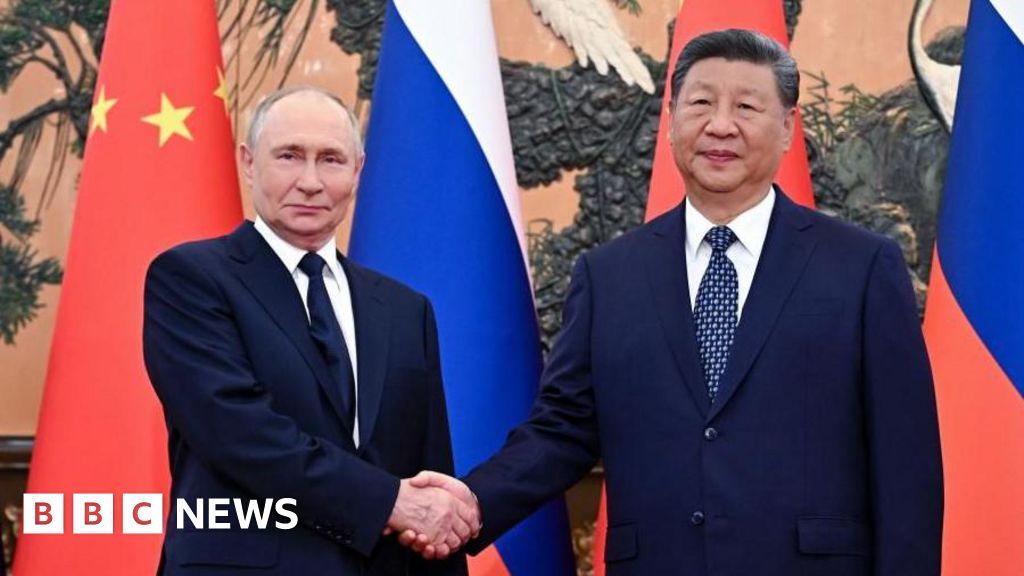
Trump's nuclear arms control push with Russia hinges on ChinaImage Credit: BBC News
Key Points
- •WASHINGTON – The future of global nuclear arms control is facing its most significant paradigm shift since the Cold War, as the Trump administration's insistence on including China in any new treaty framework creates a high-stakes diplomatic standoff with both Beijing and Moscow. With the foundational New START treaty set to expire in February 2021, the world's three largest nuclear powers are locked in a strategic stalemate that threatens to unravel decades of non-proliferation efforts and potentially trigger a costly new arms race.
- •The Core U.S. Argument: A bilateral treaty that limits U.S. and Russian strategic warheads to 1,550 each (under New START) becomes a strategic liability if China continues its unconstrained nuclear buildup. U.S. negotiators contend they cannot accept limits that would effectively allow China to approach parity over the long term.
- •Disparity in Arsenals: While exact figures are secret, independent estimates from organizations like the Federation of American Scientists place the U.S. and Russian stockpiles at roughly 6,000 total warheads each. China's arsenal is estimated to be around 320 warheads—less than 5% of either superpower's total.
- •Doctrine of "Minimum Deterrence": China maintains that its nuclear force is purely defensive, sized only to the minimum level necessary to deter an attack. Officials state they will not entertain negotiations until the U.S. and Russia reduce their arsenals to levels comparable to China's.
- •Sovereignty Concerns: Beijing views the American push as a tactic to constrain its military modernization and its rise as a global power, framing participation in talks as a capitulation to U.S. pressure.
Trump's nuclear arms control push with Russia hinges on China
WASHINGTON – The future of global nuclear arms control is facing its most significant paradigm shift since the Cold War, as the Trump administration's insistence on including China in any new treaty framework creates a high-stakes diplomatic standoff with both Beijing and Moscow. With the foundational New START treaty set to expire in February 2021, the world's three largest nuclear powers are locked in a strategic stalemate that threatens to unravel decades of non-proliferation efforts and potentially trigger a costly new arms race.
The White House's position is unequivocal: the bipolar arms control architecture of the 20th century is obsolete. U.S. officials argue that any future agreement that constrains only Washington and Moscow while leaving Beijing free to expand its rapidly modernizing arsenal is strategically untenable.
This demand marks a fundamental break from the past, moving the goalposts from a bilateral negotiation to a trilateral one—a complex geopolitical maneuver for which there is no precedent and, currently, no buy-in from China.
A New Geopolitical Reality
The administration’s stance is rooted in a sober assessment of the shifting global power dynamic. The Cold War's two-player game has been replaced by a multipolar world where China is no longer a developing nuclear state but a strategic peer competitor.
This shift was a key driver behind the U.S. withdrawal from the 1987 Intermediate-Range Nuclear Forces (INF) Treaty. Washington argued the pact unfairly restrained the U.S. and Russia while China, unburdened by its constraints, developed a formidable arsenal of intermediate-range missiles.
- The Core U.S. Argument: A bilateral treaty that limits U.S. and Russian strategic warheads to 1,550 each (under New START) becomes a strategic liability if China continues its unconstrained nuclear buildup. U.S. negotiators contend they cannot accept limits that would effectively allow China to approach parity over the long term.
Beijing's Firm Refusal
China has consistently and forcefully rejected all calls to join trilateral arms talks. Its officials frame the U.S. demand as an attempt to divert attention from America's own role in destabilizing the global security environment and to place an unfair burden on a nation with a comparatively small nuclear force.
Beijing’s arguments are centered on the vast disparity in nuclear capabilities.
- Disparity in Arsenals: While exact figures are secret, independent estimates from organizations like the Federation of American Scientists place the U.S. and Russian stockpiles at roughly 6,000 total warheads each. China's arsenal is estimated to be around 320 warheads—less than 5% of either superpower's total.
- Doctrine of "Minimum Deterrence": China maintains that its nuclear force is purely defensive, sized only to the minimum level necessary to deter an attack. Officials state they will not entertain negotiations until the U.S. and Russia reduce their arsenals to levels comparable to China's.
- Sovereignty Concerns: Beijing views the American push as a tactic to constrain its military modernization and its rise as a global power, framing participation in talks as a capitulation to U.S. pressure.
Moscow's Strategic Calculus
Russia, while publicly supporting the idea of bringing China to the table, has played a more nuanced role. Moscow has signaled its readiness to extend the existing New START treaty for up to five years—an option built into the original agreement—to provide stability and buy time for more complex negotiations.
The Kremlin understands that a complete collapse of the arms control framework is not in its interest, as it would force a financially draining arms race that its economy is ill-equipped to sustain. However, it also sees an opportunity in the U.S.-China friction.
- Leverage and Ambiguity: By positioning itself as a potential mediator, Russia gains diplomatic leverage. Moscow has also used the uncertainty to justify its own development of advanced strategic weapons, including hypersonic glide vehicles and nuclear-powered cruise missiles, which it claims are necessary to counter U.S. missile defenses.
Echoes of the Cold War
This period of uncertainty, while perilous, is not entirely unprecedented. History offers brief examples of gaps in formal arms control treaties between Washington and Moscow.
Before the Soviet Union's collapse, President Jimmy Carter’s administration delayed the ratification of the SALT II treaty to protest the 1979 Soviet invasion of Afghanistan. Crucially, both nations agreed in the interim to abide by the terms of the unratified treaty, which eventually went into effect.
- Then vs. Now: The key difference between that historical episode and today's crisis is structural. The Carter-era pause was a temporary political protest within an established and accepted bilateral framework. Today's impasse represents a fundamental disagreement over who should even be part of that framework, driven by the rise of a third major nuclear power.
The High Cost of a New Arms Race
Should the New START treaty expire in early 2021 without a replacement or an extension, the world would be without any legally binding limits on U.S. and Russian nuclear forces for the first time in nearly half a century. The implications would be severe and far-reaching.
- Economic Strain: A new, unconstrained arms race would place immense pressure on national budgets. The U.S. is already embarking on a multi-decade nuclear modernization program estimated to cost over $1.2 trillion. An arms race would inflate these costs dramatically, diverting resources from other critical economic and social priorities.
- Strategic Instability: The verification, inspection, and data-sharing protocols of New START provide crucial transparency. Without them, mistrust and suspicion would escalate, increasing the risk of miscalculation and accidental conflict in a crisis.
- Global Proliferation: The erosion of arms control at the top could weaken the entire global non-proliferation regime. If the world's largest nuclear powers abandon constraints, smaller nations may feel compelled to develop their own nuclear deterrents, sparking regional arms races.
The Path Forward: A Standoff with No Easy Exit
The international community is now watching a high-stakes clock run down. The path forward is fraught with difficulty, as the core positions of the three main actors appear irreconcilable.
U.S. diplomats continue to exert public pressure on Beijing, while Russia advocates for a simple extension of New START to maintain a floor of stability. China, for its part, shows no signs of budging.
The most likely near-term outcome may be a frantic, last-minute negotiation over a short-term extension of New START to avert a complete collapse of the arms control regime. But this would only postpone the central, unresolved question: how to build a security architecture for a world with three competing nuclear superpowers. Until that question is answered, the global strategic landscape will remain on a knife's edge.
Source: BBC News
Related Articles
Nationwide Protests Against ICE Enforcement Erupt in U.S.
Thousands are protesting ICE after the DOJ declined to investigate a fatal agent-involved shooting in Minneapolis, fueling a national movement and public anger.
Venezuela Amnesty Bill Could Free Political Prisoners
Learn about Venezuela's proposed amnesty bill to release political prisoners. The move could signal a major political shift and affect future economic sanctions
Pokémon Cancels Yasukuni Shrine Event After Backlash
The Pokémon Company has canceled an event at Tokyo's controversial Yasukuni Shrine after facing international backlash from China and South Korea.
US to Lose Measles Elimination Status: What It Means
The U.S. is poised to lose its measles elimination status due to escalating outbreaks. Learn what this downgrade means for public health and the economy.